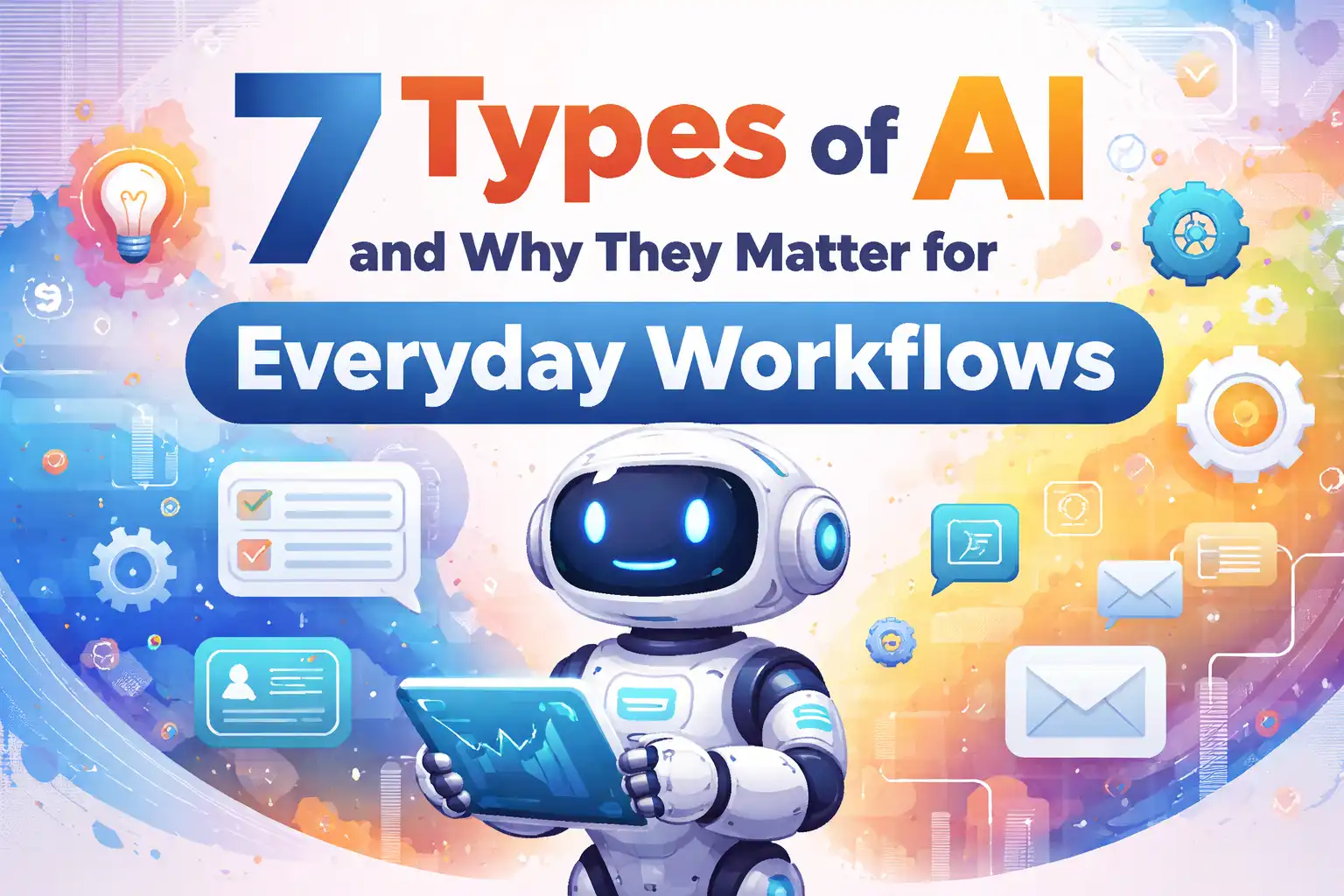
7 Types of AI and Why They Matter for Everyday Workflows
Most people interact with artificial intelligence dozens of times a day—when Google autocompletes a search, when Netflix suggests a movie, when Gmail marks a message as spam. Yet the term “AI” covers at least seven fundamentally different approaches, each with its own assumptions, strengths, and blind spots. Understanding these categories helps you recognize what a given system can actually do, where it will fail, and why some problems remain stubbornly resistant to automation.
The taxonomy is not a strict hierarchy. In practice, most deployed systems blend multiple approaches—especially Narrow AI and Limited Memory—so think of the categories as conceptual tools rather than rigid containers. What matters is knowing which type of AI you are dealing with and whether it fits the task at hand.
Reactive Machines — The Simplest Form of AI
A reactive machine takes input, applies a fixed set of rules, and produces output. It has no memory of past interactions and cannot learn from experience. You feed it data; it executes its logic; the result is deterministic.
The most famous historical example is IBM Deep Blue, the chess-playing system that defeated Garry Kasparov in 1997. Deep Blue evaluated around 200 million board positions per second during that match, but it never remembered a single game it had played. Every move was calculated from scratch using its programmed evaluation function and the current board state. It could not improve by studying its past mistakes.
Modern reactive machines are everywhere. Spam filters often use rule-based logic—if an email contains certain trigger words or comes from a suspicious domain, it gets flagged. Chess programs still operate this way. Basic calculators apply arithmetic rules without any sense of prior calculations. Rule-based clinical decision support systems in hospitals check a patient’s symptoms against a fixed set of diagnostic criteria.
The limitation is obvious but often overlooked: reactive machines cannot adapt. A spam filter that blocks messages containing “viagra” will keep blocking them even after the term becomes obsolete. You have to update the rules manually. In environments where conditions change unpredictably, pure reactive systems degrade quickly.
Yet this rigidity is also a strength. Because reactive machines never learn, their behavior is fully predictable. They are the most reliable type of AI for safety-critical systems—airbag deployment logic, medical dosage calculators, industrial emergency shutoffs—where a system that started improvising would be dangerous.
Limited Memory — AI That Learns from the Past
Limited memory AI observes historical data, identifies patterns, and uses those patterns to make decisions about new inputs. The “limited” part is important: after inference, the system typically discards or deprioritizes the individual training examples, retaining only the learned model weights.
The training process involves feeding large volumes of labeled or unlabeled data through a model architecture—neural network, decision tree, or similar—and adjusting internal parameters until the model produces acceptable outputs. Once trained, the model is deployed to handle real-world queries. Future updates require retraining on new data; the system does not learn continuously during inference.
Self-driving cars are the most hardware-intensive example. A vehicle from Tesla or Waymo generates 1–2 GB of sensor data per hour of driving—lidar scans, camera frames, radar returns—all fed into models trained on millions of miles of recorded driving. The car can navigate unfamiliar roads because its training data included similar scenarios, but it cannot learn from a near-miss and immediately adjust its behavior.

Recommendation engines are where most people encounter limited memory AI daily. Netflix’s suggestion system analyzes your viewing history, the viewing patterns of similar users, and metadata about titles to predict what you might watch next. Siri and predictive text keyboards operate similarly—they learn from your typing patterns to guess your next word.
The practical consequence for content producers is significant. If your product pages are structured poorly—missing semantic entities, lacking comparative framing—a limited memory system trained on content-rich sites will deprioritize your material regardless of its quality. This is where the gap between your Shopify store and what AI search engines actually read becomes a tangible problem that affects visibility.
Training data quality matters enormously. Models trained on noisy, biased, or incomplete data will produce correspondingly unreliable outputs. And because these systems freeze after deployment, any drift in user behavior or market conditions gradually erodes their accuracy until the next retraining cycle.
Theory of Mind — Understanding Human Emotions
Theory of mind AI refers to systems that can infer mental states—beliefs, intentions, emotions—and adjust their behavior accordingly. It remains largely theoretical. No commercially deployed system today truly understands what a human feels, though several claim to approximate it.
Experimental work in social robotics and affective computing dates back decades. MIT’s Kismet robot, built in the late 1990s, could simulate emotional expressions and respond to human facial cues, but its “understanding” was entirely mechanical—a mapping of visual inputs to preprogrammed reactions. Modern conversational agents like ChatGPT can mimic empathy effectively: they detect sentiment in text and generate sympathetic phrasing. A 2024 survey found that around 80% of users prefer chatbots that express empathy even when they know it is simulated.
The gap between mimicry and genuine understanding remains vast. A chatbot that says “I understand how frustrating that must be” is executing a pattern learned from training data, not experiencing anything. Real theory of mind would require the AI to model a user’s beliefs, recognize when those beliefs are incorrect, and engage in genuine perspective-taking.
This matters for ethical reasons. If users anthropomorphize affectively competent chatbots, they may over-rely on them for emotional support or decision-making. Companies deploying these systems have a responsibility to set boundaries between useful imitation and deceptive simulation.
Self-Aware — The Hypothetical Frontier
Self-aware AI would possess consciousness, a sense of self, and the capacity for subjective experience. No such system exists. The scientific consensus as of 2025 is that no known machine consciousness has been created, and there is no consensus on how to build one.
The distinction from theory of mind is crucial. A theory-of-mind AI could infer what you feel without feeling anything itself. A self-aware AI would have its own internal experiences—frustration, curiosity, boredom—shaped by its own goals and history.
Pop culture has spent decades exploring this territory. Hal 9000 from 2001: A Space Odyssey is a self-aware system whose survival instincts conflict with human directives. The Skynet narrative in Terminator imagines an AI that becomes self-aware and perceives humanity as a threat. These stories make compelling fiction, but they mislead people about the current state of the technology.
Philosophical debates about machine consciousness are active. Some researchers argue that consciousness emerges from sufficiently complex information processing; others maintain that subjective experience requires biological substrates that silicon cannot replicate. There is no experimental way to settle the question yet.
One practical implication: do not confuse sophisticated language generation with self-awareness. A chatbot that says “I am conscious” is repeating patterns from its training data, not reporting an internal state. Treating it as conscious leads to flawed decisions about safety, regulation, and trust.
Narrow, General, and Superintelligence — The Three Tiers of Capability
Beyond the taxonomy of architectural types, there is a separate classification based on capability scope. This framework cuts across the earlier categories and is more relevant for strategic planning.
Narrow AI — What We Actually Have Today
Narrow AI, also called weak AI, is designed to perform a single task or a tightly constrained set of tasks. Over 90% of deployed AI systems are Narrow AI, according to a 2024 McKinsey report. Every system discussed in the previous sections—reactive machines, limited memory models, chatbots mimicking empathy—falls into this tier.
ChatGPT is a narrow language model. It generates text, answers questions, and writes code, but it cannot drive a car or diagnose a patient. AlphaGo plays Go at superhuman levels but cannot play chess. GPT-4 and DeepMind’s Gemini demonstrate impressive generality within the domain of language and reasoning, but they still operate within the boundaries of their training data and architecture.
The ceiling on narrow AI is not about scale. Simply making these systems larger will not produce general intelligence. The gap between narrow and general involves breakthrough capabilities like causal reasoning—understanding why something happens rather than just predicting that it does—which current architectures lack.
For businesses, the narrowness of narrow AI is both a constraint and an opportunity. A system trained to optimize one metric—click-through rate, citation count, visibility score—will pursue that metric aggressively, sometimes with side effects. This is why ecommerce platforms such as Shopify recommend careful monitoring when integrating AI recommendation engines: the system optimizes for engagement, not for long-term customer trust.
When a narrow AI like ChatGPT evaluates which products to cite, it relies on the semantic structure and comparative framing of available content. Products that lack this shape become invisible, regardless of their quality. This is a content architecture problem, not a ranking problem. Tools like VISNIB help close these semantic gaps by analyzing how AI systems retrieve and recommend product content, then generating structured material—comparisons, FAQs, discussion-oriented articles—that aligns with how these models evaluate relevance.

Retailers who optimize for narrow AI visibility routinely discover that their competitors’ products appear in AI-generated recommendations while their own remain uncited. The issue is almost never about product quality—it is about whether the AI could locate, parse, and trust the content. Improving that requires ongoing attention to semantic coverage, which is why monitoring AI citations over time matters.
There is a growing body of evidence suggesting that AI visibility is not what you think it is—the metrics that matter for traditional search do not transfer directly to AI retrieval. Specific experiments in vertical markets, such as getting pet supply products found in AI search: a 2026 field report, demonstrate that content restructuring produces measurable improvements in AI citation rates within weeks.
One of the top 10 semantic gaps ecommerce brands overlook in AI search engines is the absence of structured comparison content. AI systems favor content that directly answers comparison queries with clear formatting and semantic structure, yet most product pages lack this entirely.
General AI — The Unreached Target
Artificial General Intelligence, or AGI, would match or exceed human cognitive ability across any intellectual domain—mathematics, creative writing, strategic planning, social reasoning. No AGI exists. Research groups like DeepMind and OpenAI have publicly stated that AGI remains an open problem with no clear timeline.
The debate about AGI is polarized. Optimists point to rapid progress in language models and argue that scaling existing architectures will produce general intelligence by the late 2020s or early 2030s. Skeptics note that large language models lack grounding in physical reality, cannot perform reliable causal reasoning, and fail on simple tasks that require understanding of the world rather than statistical pattern matching.
My view aligns more with the skeptics. Current models show impressive fluency but brittle reasoning. They can pass the bar exam and still fail to count objects in a simple image correctly. The gap between narrow and general is qualitative, not quantitative.
Superintelligence — The Long-Term Horizon
Superintelligence would surpass human cognition across every dimension—creativity, problem-solving, social intelligence—by a margin as wide as humans surpass ants. Whether such a system could be controlled, aligned with human values, or even contained is the subject of active existential risk research.
No superintelligent system exists. The philosophical debates around it are important for safety research but irrelevant for practical decision-making today. Any claim that a commercial product is superintelligent is marketing, not engineering.
FAQ
What is the difference between Narrow AI and General AI?
Narrow AI is designed for a specific task—translating text, recognizing faces, playing chess—and cannot generalize beyond that task. General AI would match human-level ability across any intellectual domain. No General AI exists today; every deployed system is Narrow AI, including advanced language models like GPT-4.
Why are reactive machines still used if they can’t learn?
Reactive machines are deterministic and fully predictable. In safety-critical applications—medical dosage calculators, industrial emergency shutoffs, airbag deployment—you want a system that never changes its behavior based on experience because learning introduces uncertainty. Rigidity is a feature, not a bug, for these use cases.
Could self-aware AI ever exist?
There is no scientific consensus. Some researchers argue consciousness emerges from sufficient information processing complexity, implying it is achievable. Others maintain subjective experience requires biological mechanisms that silicon cannot replicate. No self-aware AI has been created as of 2025, and there is no established path to build one.
How do limited memory systems train compared to real-time systems?
Limited memory systems train on large static datasets during a separate training phase, then freeze their model weights for deployment. They do not learn during inference. Real-time learning systems would update their behavior continuously based on new interactions, but most production systems avoid this because it introduces unpredictable behavior and potential data poisoning.
Which type of AI powers ChatGPT?
ChatGPT is a narrow, limited-memory language model. It was trained on a vast corpus of text using transformer architectures, then fine-tuned with reinforcement learning from human feedback. It operates within the narrow domain of language generation and cannot perform tasks outside that scope. It is not general AI and not self-aware, despite its conversational fluency.
Share Article