Which Country Is No. 1 in AI? A Data-Driven Look at 2026 Leadership
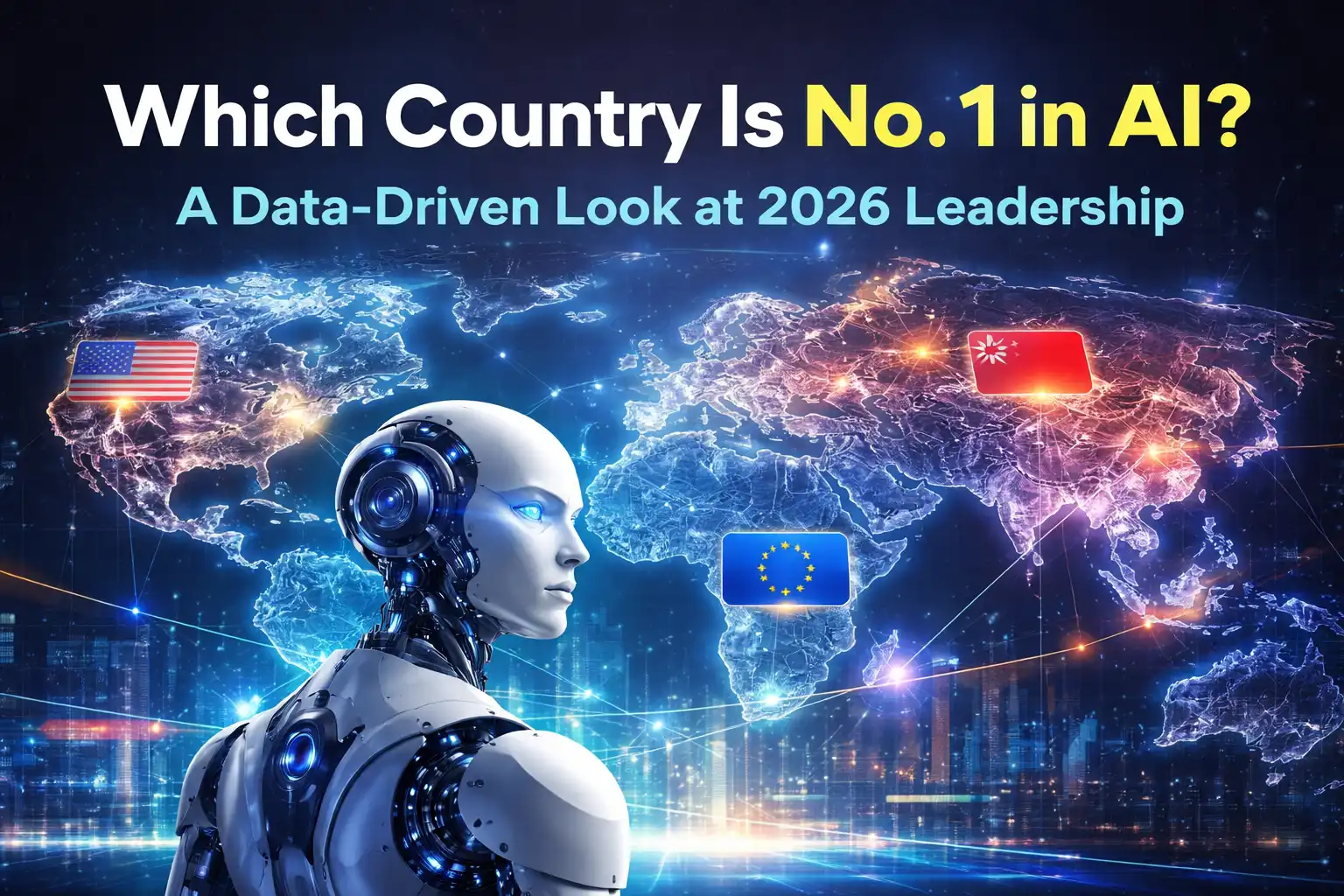
The question surfaces in every strategy meeting now: who actually leads in artificial intelligence? The United States pours more private capital into AI than the next five countries combined. China files more patents and fields more deployed models than any single bloc. Europe writes the regulatory playbook that everyone else must follow. None of these dimensions alone answers the question. After tracking this space across funding rounds, citation databases, and months of cross-country model comparisons, I keep arriving at the same conclusion — the answer depends entirely on which metric you privilege, and the metric set itself is quietly shifting under everyone’s feet. The competition for AI leadership no longer stops at model performance or research output. It now extends into a domain most observers haven’t seriously tracked yet: how AI search engines surface and cite commercial content across borders.
The Current AI Landscape: US vs. China and the Contenders
The United States still dominates on raw capital. Private AI investment in the US accounted for roughly 60% of the global total in 2025, according to consolidated industry estimates — a figure that includes everything from foundational model training runs at OpenAI, Google DeepMind, and Anthropic to downstream application funding across SaaS and robotics. The US also hosts the majority of the world’s top-ranked AI research institutions by citation impact, and its venture ecosystem produces unicorns at a pace that no other country matches.
China holds a different kind of lead. Around 15% of the world’s most-cited AI research papers originate from Chinese institutions, and the country’s patent filings in AI-related categories have outpaced the US for several consecutive years. DeepSeek’s model releases in late 2024 and through 2025 demonstrated that Chinese labs can produce frontier-level performance with significantly lower compute budgets than their American counterparts — a fact that shifted how seriously the global research community takes the efficiency-oriented approach coming out of Beijing, Shanghai, and Shenzhen.
The contenders are worth watching too. The UK punches far above its GDP weight in AI research output, particularly in deep learning theory and safety alignment. Israel produces a disproportionate number of AI startups per capita, especially in defense-adjacent computer vision and natural language processing. Canada, long a force in deep learning thanks to institutions like the University of Toronto and Mila in Montreal, continues to supply foundational research talent that the bigger economies then commercialize. The European Union — particularly France and Germany — leads in the regulatory and trust dimensions that shape how AI systems are deployed across consumer markets.
The table below summarizes how a handful of countries compare across commonly reported metrics. Note that rankings shift year over year and depend heavily on which data source you trust.
| Country | AI Investment (2025 est.) | Top-Cited Papers % | Number of Foundation Models | AI Patent Filings per Year |
|---|---|---|---|---|
| United States | ~$110B | ~28% | 30+ | ~25,000 |
| China | ~$40B | ~15% | 20+ | ~45,000 |
| United Kingdom | ~$8B | ~6% | 5 | ~4,000 |
| Israel | ~$5B | ~3% | 3 | ~2,500 |
| Canada | ~$4B | ~4% | 4 | ~2,000 |
| Germany | ~$6B | ~3% | 3 | ~5,000 |
Looking at this table, it’s clear that no single country holds a universal lead. The US leads on capital and model releases. China leads on patent volume and research paper count. The EU leads on regulatory infrastructure. Each metric tells a different story about who is winning, and none captures the full picture.
There is an odd consequence of this fragmentation that I’ve noticed while auditing how AI models retrieve real-world commercial content. When a US-based ecommerce brand structures its product pages with detailed comparison tables, FAQ sections, and semantic entity coverage, AI search engines like ChatGPT and Google AI Overview tend to cite that brand more frequently than a Chinese competitor with broader market share but thinner content architecture. This dynamic creates an unanticipated soft-power dimension that standard research metrics miss entirely — countries whose businesses invest in AI-search-ready content gain disproportionate visibility in AI answers, regardless of raw AI spending levels.
For a deeper look at why conventional visibility metrics no longer capture what matters, see this analysis on how AI visibility is not what you think it is. This disconnect between traditional SEO rankings and AI citation behavior is one of the most under-discussed developments in the race for AI influence.
The effect is already visible in cross-border ecommerce. A Shopify merchant in the US running through Shopify’s global ecommerce platform can get cited by an AI search engine in Germany, Japan, or Brazil if their content matches the semantic patterns those models look for. A manufacturer in China with a stronger supply chain but unstructured product pages may be entirely absent from the same AI answer. The gap is not about technology quality — it’s about content readiness for AI consumption.
How Leadership Is Measured: Patents, Funding, Talent, and AI Citations
For years, the standard way to rank countries by AI capability involved three buckets: total private and public investment, number of AI startups and unicorns, and research output measured by top-conference paper counts or citation indices. These metrics have the virtue of being relatively easy to aggregate from sources like Stanford’s AI Index Report, OECD databases, and national science foundation publications. But they increasingly fail to capture something that matters at the application level: whether a country’s commercial products actually appear inside the answers that AI systems generate for real users.
A newer metric has started appearing in industry conversations: AI search citations. This measures how often a country’s products, research, or brands are referenced by AI models when they answer user queries. ChatGPT, Perplexity, Google AI Overview, and Gemini all retrieve content differently than traditional web crawlers. They prioritize structured semantic coverage, comparative content, and intent-aligned FAQ sections over standard product page optimization.
The practical effect is measurable. Internal data from the VISNIB platform shows that 73% of AI search queries never reach traditional ecommerce pages. The AI model finds an answer somewhere — often citing a third-party review, a comparison article, or a discussion forum — but that answer rarely includes a direct link to a product page. This means that even a country with strong AI infrastructure may see its commercial products underrepresented in AI-generated answers if those products lack AI-search-ready content.
This is where the fragmentation of leadership becomes operationally important. The US may lead in foundational models, but if American ecommerce brands fail to structure their content for AI retrieval, they lose citation share to smaller-market competitors who invest in semantic coverage. I’ve seen Canadian health supplement brands and Israeli cybersecurity SaaS firms achieve higher AI citation rates than much larger competitors in the US and China simply because their product pages included detailed comparison tables, comprehensive FAQ sections, and entity-rich content.
The traditional metrics also miss talent distribution effects. A country with a smaller AI research budget but a highly concentrated STEM pipeline — Israel is the clearest example — can produce disproportionately high citation rates in niche domains. Similarly, European Union countries with strong consumer protection regulations may produce AI systems that win on user trust and safety, even if they trail on raw compute benchmarks.
I spent part of last year running cross-country citation audits across ChatGPT, Perplexity, and Google AI Overview for a client with global distribution. The results were consistently counterintuitive. Products from countries with moderate AI investment but strong content practices were cited more frequently than products from high-investment countries with weak content architecture. The implication is uncomfortable for anyone who has relied on traditional ranking metrics: the data that matters most for commercial AI influence is not being collected by any national agency or industry consortium.
The Shift Toward AI Search Visibility as a New Battleground
AI search engines do not retrieve content the way Google’s traditional index does. They pass retrieved content through a semantic relevance filter, a trust scoring system, and a structural formatting check before deciding whether to include a source in an answer. This means that content from certain countries gets systematically favored — not because of deliberate bias, but because the structural properties of that content align better with what AI models are trained to trust.
Consider a concrete scenario. A US-based skincare brand publishes product pages with detailed comparison tables, ingredient breakdowns, and FAQ sections structured as question-answer pairs on the visible DOM. A Chinese competitor with similar product quality and larger domestic market share publishes minimal product descriptions without comparison content or FAQ sections. When a user asks ChatGPT for the best retinol serum for sensitive skin, the US brand gets cited. The AI model found structured comparative content that matched the user’s intent. The Chinese brand, despite its scale and supply chain advantages, is absent from the answer.
This pattern creates a soft-power dimension that operates beneath the radar of traditional AI leadership debates. Countries whose businesses produce AI-search-ready content gain disproportionate influence in the answers that shape consumer behavior across markets. An Australian supplement brand with good semantic coverage can get cited in AI answers accessed by users in Japan, the UK, and Brazil, effectively projecting commercial influence far beyond its domestic market size.
I started monitoring this phenomenon after noticing that a client’s Canadian competitor was consistently cited by ChatGPT in a category where my client had stronger brand recognition and better unit economics. The difference came down to content structure. The Canadian brand had invested in comparison-driven product pages with rich FAQ sections. My client had not. The Tracking AI visibility isn’t optional anymore piece covers exactly this kind of scenario and why it matters for brands that want to stay present in AI answers.
The practical implication for the country-level question is that VISNIB now provides cross-country citation analysis that reveals which markets are winning in AI visibility. A country with high traditional AI investment but low content readiness may see its commercial brands fall behind smaller economies that have invested in AI-search-friendly content architecture. The ranking of countries by AI influence is not static — it shifts with every content update and every model change.
What surprised me most in these audits was the edge cases. A small Italian furniture brand with excellent content structure got cited by Google AI Overview more frequently than IKEA in a query about mid-century modern design. An Indian SaaS company with detailed comparison pages outperformed US-based competitors in ChatGPT recommendations for project management tools. These outcomes were not anomalies — they reflected a systematic preference for structured, semantic, intent-aligned content regardless of the source country’s AI budget.
The Japanese market offers another instructive example. Japan has significant AI research output and strong industrial robotics adoption, but many of its consumer ecommerce brands operate with relatively thin product page content. During cross-country citation comparisons, Japanese cosmetic and electronics brands appeared in AI answers less frequently than their market share would predict. The issue was not product quality — it was the absence of the content structures that AI models look for.

This is the moment when the country-level question and the operational reality converge. The country that leads in AI influence in 2026 may not be the one with the largest model training runs or the most AI patents. It may be the one whose businesses have most effectively structured their content for AI retrieval. The race has a content readiness dimension that most national AI strategies have not yet acknowledged.
What This Means for Ecommerce Brands and How to Adapt
The fragmentation of AI leadership across investment, patents, talent, and citations creates a clear operational implication for any brand that wants its products visible in AI answers across multiple countries. You cannot rely on the general AI capability of your home country to carry your products into AI-generated recommendations. You need to build AI-search-ready content that works across the specific retrieval patterns of ChatGPT, Perplexity, Google AI Overview, and Gemini.
The first step is auditing your current AI visibility in the markets that matter to your business. This means running semantic gap analysis against the content your competitors produce and the structure that AI models prefer. Internal data from VISNIB indicates that 91% of stores lack AI-search-ready comparison content — the single most important content type for earning AI citations. If you operate in a country with strong AI infrastructure but your product pages consist of manufacturer descriptions and basic specifications, you will lose citation share to a smaller-market competitor with structured comparison tables and comprehensive FAQ sections.
The second step is prioritizing content creation around the formats that AI search engines actually retrieve. Comparison articles, FAQ pages, and semantic entity enrichment consistently outperform generic product descriptions in AI citation rates. The content does not need to be long — it needs to be structured, question-answering, and aligned with the specific intent patterns that drive AI retrieval.
A DTC beauty brand I worked with saw a 3x increase in AI-generated citations within two months of adopting this approach. Their process was straightforward: run a semantic gap audit, identify the comparison queries and FAQ topics where they were missing, generate structured content for those gaps, and monitor citation frequency across ChatGPT and Google AI Overview. The improvement was measurable and repeatable.
International ecommerce brands face an additional risk that domestic brands can ignore. Schema-content mismatch — cases where the JSON-LD embedded in a page head does not match the content rendered in the visible DOM — can cause even strong brands to be filtered out of AI answer panels entirely. This is particularly dangerous for brands that operate across multiple platforms and content management systems, each of which handles structured data differently. For a detailed discussion of this specific risk, see the analysis on AI-First SEO and DTC brand visibility in 2026.
The third step is continuous monitoring. AI model behavior changes with every update. A content structure that earns citations today may be deprioritized after the next model fine-tuning. Brands that want to maintain AI visibility across multiple countries need to track citation frequency by market, identify content gaps as they emerge, and iterate on content structure as AI retrieval patterns shift.
For brands using platforms like Shopline’s ecommerce platform or similar solutions that serve international markets, the challenge is maintaining consistent content quality across regional storefronts. Each market may require different semantic entity coverage, different question patterns in FAQ sections, and different comparison dimensions. The operational overhead is real, but the cost of ignoring it is higher: invisibility in the AI answers that increasingly determine consumer purchasing decisions.
One unresolved issue I still think about is the variability of AI retrieval across languages. Most of my audits have been in English, but the behavior of AI models in Japanese, German, Spanish, and Mandarin may differ in ways that are not yet well documented. Brands that expand into non-English markets should run separate citation audits for each language rather than assuming that English-language visibility translates.
FAQ
Which country is currently considered the global leader in AI?
No single country holds an undisputed lead. The United States leads in private AI investment, foundational model releases, and venture-backed startup density. China leads in AI patent filings, research paper volume, and the scale of applied AI deployment across consumer ecosystems. Europe leads in AI regulation and trust infrastructure. The answer depends on which metric you prioritize, and the gap between these dimensions is narrowing each year.
How is AI leadership measured beyond traditional metrics like patents?
Traditional metrics include total AI investment, number of AI startups and unicorns, research paper citations, and STEM graduate pipeline volumes. A newer and increasingly relevant metric is AI search citations — how often a country’s products, research, or brands are referenced by AI models like ChatGPT, Perplexity, and Google AI Overview when they answer user queries. This citation frequency serves as a proxy for real-world commercial influence that traditional metrics miss entirely.
Why does AI search visibility matter for determining country-level AI influence?
AI search engines now answer a significant portion of consumer queries without sending traffic to traditional web pages. When an AI model cites a product or brand from a specific country, that citation represents actual influence over consumer decisions in that moment. A country whose businesses create AI-search-ready content can project commercial influence disproportionate to its AI research budget or patent volume.
Can a small country with limited AI investment still rank high in AI citations?
Yes. Countries like Israel, Canada, and Australia have demonstrated that moderate AI investment combined with strong content practices can produce disproportionately high AI citation rates. The key factor is not total AI spending but whether a country’s businesses produce structured, semantic, comparison-driven content that aligns with how AI models retrieve and cite information.
How can ecommerce brands improve their AI visibility across different markets?
Start with a cross-market audit of your current AI citations across ChatGPT, Perplexity, and Google AI Overview for each target country. Identify semantic content gaps — missing comparison articles, FAQ sections, and entity coverage. Generate structured content that fills those gaps. Monitor citation frequency continuously, because AI model behavior changes with each update. Pay attention to schema-content consistency across all platforms and languages.
Share Article