Who Are the Big 5 in AI? A Straightforward Breakdown
Anyone asking who the big five in AI are is usually trying to understand which companies actually control the models behind ChatGPT, Google Search, and every AI-powered tool their business relies on. The answer matters because these five companies determine how AI systems retrieve, rank, and recommend content—which directly affects whether your products get seen or stay invisible in the new search landscape.
It’s not a theoretical question. If you run an ecommerce store, a SaaS platform, or any content-driven business, the models these companies build are now the gatekeepers between what you publish and whether potential customers ever encounter it. Understanding who they are and how they operate is the first step toward making your content visible in AI-powered discovery.
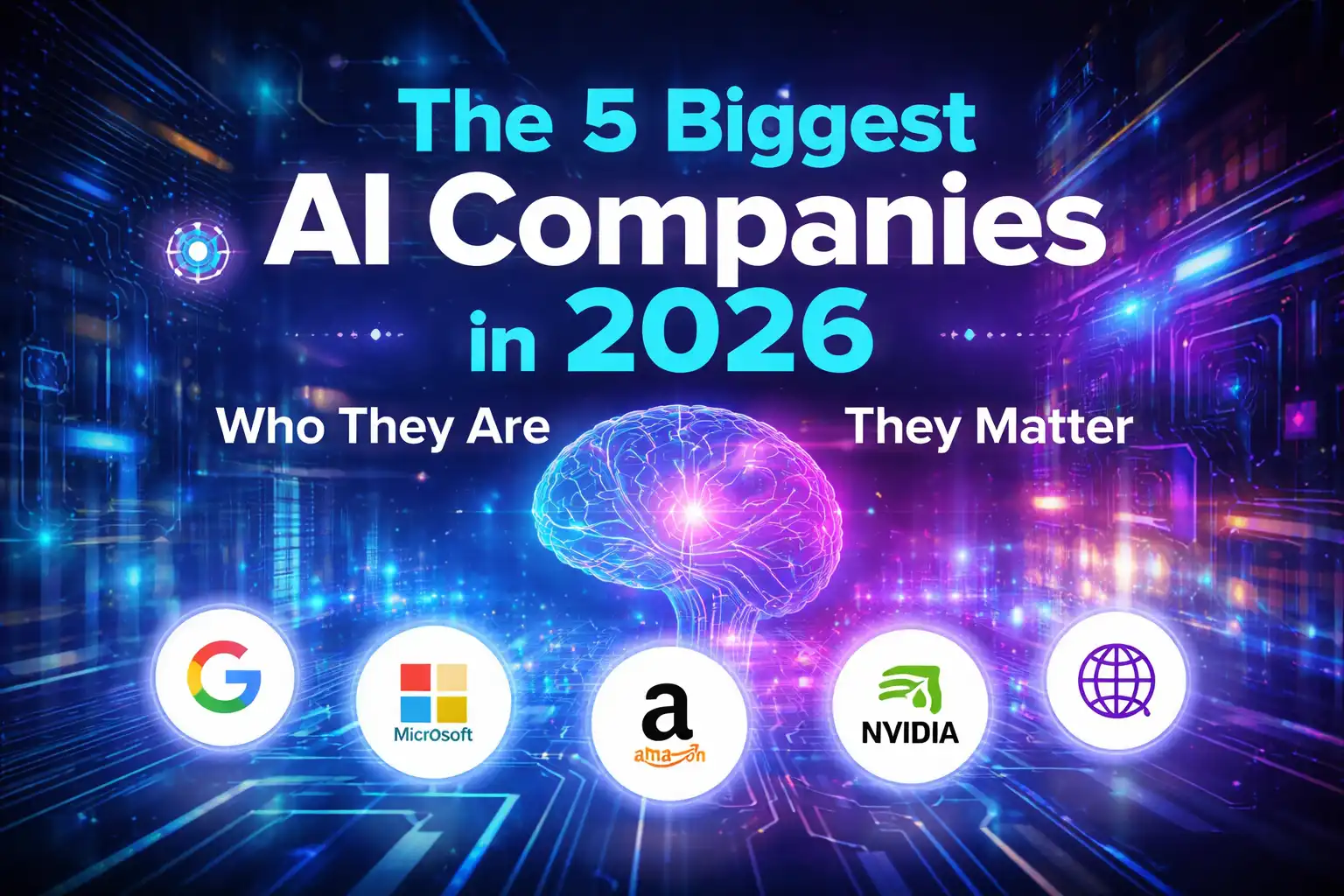
The Five Companies Defining Modern AI
The landscape of foundational AI models is concentrated around five organizations. Each brought something distinct to the table, and their relative influence shapes everything from consumer chatbots to enterprise search infrastructure.
OpenAI is the most visible name in consumer AI. ChatGPT reached 100 million users within two months of launch, a growth rate no software product had ever achieved. Its GPT-4 model powers ChatGPT, the API that thousands of third-party applications rely on, and Microsoft’s Copilot. OpenAI’s strength is breadth—its model handles general knowledge, creative writing, reasoning, and code generation with consistent fluency. For businesses, this means ChatGPT is often the first AI system a customer turns to when researching products or services.
Google DeepMind operates from a different position entirely. Google’s Gemini model is integrated directly into the world’s largest search engine. When a user types a query and sees an AI-generated summary at the top of the results, that’s Gemini at work. Google’s advantage is distribution—billions of searches per day mean Gemini influences more individual queries than any other model. The tradeoff is that Google must balance AI output with its traditional advertising business, which creates tension around how much information gets surfaced before a user clicks.
Microsoft Azure AI took a pragmatic approach: partner with OpenAI, integrate GPT-4 into Bing and Office products, and sell enterprise access through Azure. Microsoft’s Copilot product line—embedded in Windows, Teams, and GitHub—makes AI a productivity tool rather than a standalone chatbot. For enterprise buyers, Microsoft offers a path that feels safer: existing contracts, compliance frameworks, and familiar interfaces with AI layered on top.
Anthropic positioned itself as the safety-first alternative. Its Claude model emphasizes aligned behavior, reduced hallucination, and refusal to engage with harmful inputs. Anthropic’s enterprise adoption has grown steadily because Claude handles long-context documents better than most competitors and provides more reliable citations. For industries where accuracy and auditability matter—legal, medical, financial—Claude has become a default choice.
Meta AI took the open-source route. Its LLaMA models are released publicly, allowing developers to fine-tune, modify, and deploy them without licensing constraints. This strategy has made LLaMA the backbone of countless custom AI systems running on private infrastructure. Meta doesn’t monetize its models directly, but the strategy feeds its ecosystem—better open-source models mean better AI features across Facebook, Instagram, and WhatsApp, which keeps users engaged.
Each of the five operates with different priorities, but their outputs converge in one important way: they all influence what information gets surfaced, summarized, and recommended to users. That convergence is what makes them the big five, not just the five biggest.
How Each Big 5 Company Shapes AI Search and Discovery
The shift from traditional search to AI-mediated discovery happened gradually, then suddenly. By early 2025, Google AI Overview was appearing on a significant percentage of search results pages, providing direct answers that kept users from clicking through to websites. Bing Copilot offered a chat interface alongside traditional results. ChatGPT Search became a standalone tool that bypassed conventional search engines entirely.
For ecommerce stores, the impact was immediate. One client I worked with saw organic traffic from product comparison queries drop 40% over three months. The traffic wasn’t going to competitors—it wasn’t going anywhere. AI systems were answering the query directly using information the client had published, but without sending visitors to their site.
Google AI Overview pulls from sources it trusts—structured content, authoritative domains, pages with clear semantic signals. If your product pages lack comparison tables, FAQ sections, or comprehensive feature breakdowns, Gemini won’t cite you. The model favors content that mirrors its own training data format: well-organized, explanatory, and connected to related topics.
ChatGPT Search operates differently. It uses GPT-4 to interpret queries and retrieve information it considers relevant, often pulling from published web content. But OpenAI’s model prioritizes conversational completeness—it wants to answer the question fully, not just return a list of links. This means products described only as bullet points on a bare product page rarely get mentioned. The model looks for context: why someone would buy this product, how it compares to alternatives, what problems it solves.
Bing Copilot, powered by OpenAI’s models but filtered through Microsoft’s search infrastructure, sits somewhere in between. It provides citations more consistently than ChatGPT but still summarizes rather than redirects traffic. For enterprise search scenarios—employees researching vendors or procurement teams evaluating tools—Copilot has become a primary interface.
Claude’s role in search is less direct but no less important. Anthropic’s model is increasingly embedded in enterprise knowledge management systems and internal search tools. When a company deploys Claude to answer employee questions about products or processes, the model’s citations determine what information gets surfaced internally. If your documentation isn’t structured for Claude’s reading preferences, you lose visibility inside those organizations.
Meta’s AI influences discovery through social feeds and recommendation algorithms. LLaMA-based models power content suggestions across Meta’s platforms, meaning product visibility on Instagram and Facebook is now partially driven by AI understanding of your content. The difference is that Meta’s AI optimizes for engagement rather than factual completeness, which creates a different set of content requirements.
The common thread across all five is that they rely on semantic signals your content may not be providing. You need to understand which engine drives your traffic, and the differences matter more than most marketers realize. A detailed comparison of how different AI engines rank products can help clarify which gaps to address first. For stores using Shopify’s ecommerce platform, the gap is often structural: clean product pages that work perfectly for human shoppers but carry almost no semantic context for an AI model.
Why the Big 5 Matter for Your Content Strategy
The five companies controlling foundational AI models aren’t just competing with each other—they’re also interdependent. Microsoft uses OpenAI’s technology. Google and Meta train on each other’s published research. Anthropic’s safety work informs practices across the industry. This interdependence means that optimizing for one model often improves visibility across several, but ignoring all of them guarantees invisibility.

Traditional SEO focused on ranking in Google’s top ten results. The assumption was straightforward: get to position one, get the clicks, get the conversions. That assumption is breaking down because AI systems intercept queries before they reach a results page. By early 2026, ecommerce stores started noticing that their highest-ranking product pages were generating fewer direct sales. The traffic wasn’t dropping—it was being consumed by AI answers that never sent users anywhere.
The shift from SEO to generative engine optimization (GEO) reflects this change. GEO isn’t about ranking higher—it’s about being cited within AI-generated answers. The models don’t rank pages in the traditional sense. They assess relevance, completeness, and semantic alignment with the query. A product page that answers a question directly and provides structured comparisons has a higher chance of being referenced than a page with perfect meta tags but thin content.
This is where most ecommerce brands fail. The models themselves are not content-aware in the human sense. They rely on semantic signals that most ecommerce product pages don’t provide. A typical product listing contains a title, a few bullet points, and a description focused on features. The AI model needs context: what category does this product belong to, how does it compare to alternatives, what problems does it solve, who is it for, what are the tradeoffs. 91% of stores lack AI-search-ready comparison content, which is exactly the type of content these models prioritize.
When you start auditing how your content performs across these engines, the manual effort becomes unsustainable. This is where platforms like VISNIB come in to monitor AI citations and identify missing semantic coverage across ChatGPT, Google AI Overview, Perplexity, and Gemini. The workflow changes from guessing which content to create to identifying specific gaps the AI engines are signaling. Visibility is no longer about ranking—it’s about being present in the AI’s knowledge base.
Content strategy under the big five requires three adjustments. First, every piece of content must answer specific questions rather than simply describing features. Second, comparison content—product A versus product B, use case A versus use case B—carries disproportionate weight because AI systems favor structured contrasts. Third, the content must be semantically connected to related topics so the model can place it within a broader context.
The brands that adapt early see measurable results. The ones waiting for AI search to stabilize will find their content ecosystem has been silently rewritten around them.
The Competitive Landscape Beyond the Big 5
Several other companies play significant roles in AI, but they don’t qualify as foundational model providers in the same sense. Understanding the distinction matters for resource allocation.
Amazon operates AWS AI services, which power a massive share of AI inference workloads. Amazon Bedrock gives customers access to multiple foundation models, and Amazon’s own models (Titan, Nova) are improving rapidly. Alexa remains one of the most deployed consumer AI assistants. But Amazon’s core revenue model isn’t built around its own foundational models—it’s built around platform infrastructure and retail. For content visibility, Amazon’s influence is indirect: its cloud services host the infrastructure that other AI systems run on, but its models don’t drive the search queries that determine whether your products get discovered.
Apple took a late but deliberate entry with Apple Intelligence. The company prioritizes on-device processing and privacy, which constrains how its models operate. Apple’s AI is embedded in its ecosystem rather than exposed as a general-purpose tool. It matters for iOS and macOS users, but it doesn’t shape search discovery in the same way Google or OpenAI do.
xAI’s Grok model is still early-stage. It has access to real-time data through X (formerly Twitter) and a distinctive conversational style, but its user base and integration points remain narrow. Grok influences certain niche communities but hasn’t achieved the distribution necessary to affect broad content discovery.
Nvidia is the infrastructure backbone. Its GPUs train and run almost every model from the big five. Nvidia’s market cap briefly exceeded $3 trillion, reflecting the hardware bottleneck in AI compute. But Nvidia doesn’t produce a foundational model or a search interface—it sells the tools that make AI possible. For content strategy, Nvidia is invisible regardless of how visible your content is.
Perplexity is worth watching. It functions as an AI-native search engine that draws on models from OpenAI, Anthropic, and potentially others. Perplexity is not a foundational model provider—it’s an aggregator and interface layer. Its citations matter because it attributes sources more explicitly than ChatGPT or Gemini. Perplexity’s growth suggests a market appetite for transparent, citation-heavy AI search, which could pressure the big five to become more source-transparent over time.
For content visibility, the practical takeaway is that tracking AI visibility isn’t optional anymore. Perplexity and other aggregators may draw on the same foundational models, but their citation behavior differs. A strategy that works for ChatGPT may not work for Perplexity. The big five control the models; the interface layer controls how those models surface citations.
FAQ
Which companies are considered the Big 5 in AI?
OpenAI, Google DeepMind, Microsoft Azure AI, Anthropic, and Meta AI. These five organizations develop the foundational large language models that power most consumer and enterprise AI applications. Other companies contribute through infrastructure or application layers, but the big five control the models themselves.
Why isn’t Amazon considered one of the Big 5 in AI?
Amazon’s AI efforts are substantial—AWS Bedrock, Alexa, and custom chips like Trainium—but the company doesn’t operate an independently dominant foundational model that shapes search and content discovery. Its influence is in infrastructure and retail, not in the general-purpose language models that drive how information gets retrieved and summarized for end users.
Is Nvidia part of the Big 5 AI companies?
No. Nvidia provides the hardware that trains and runs AI models, which makes it essential to the AI industry. But a chip manufacturer doesn’t control how AI systems retrieve or rank content. Nvidia’s role is foundational in the engineering sense, not in the content-discovery sense.
How do the Big 5 AI companies affect ecommerce visibility?
Each company’s model influences whether your products get mentioned in AI-generated answers. Google AI Overview cites sources in search results, ChatGPT recommends products during conversational queries, Bing Copilot provides enterprise search answers, Claude powers internal knowledge systems, and Meta’s AI shapes social feed recommendations. If your content isn’t structured for these models, your products effectively don’t exist in AI-mediated discovery.
Do I need to optimize my content differently for each Big 5 model?
Yes, but the overlaps are significant enough that prioritizing semantic completeness and comparison content benefits all of them. ChatGPT favors conversational context and thorough comparisons. Google AI Overview prefers structured, authoritative content with clear citations. Claude values long-context accuracy and well-organized documentation. Meta’s AI optimizes for engagement signals. A content strategy that fills semantic gaps and provides structured comparisons improves visibility across at least four of the five.
Share Article