What Is the 3-3-3 Rule in Marketing? A Practitioner's Breakdown
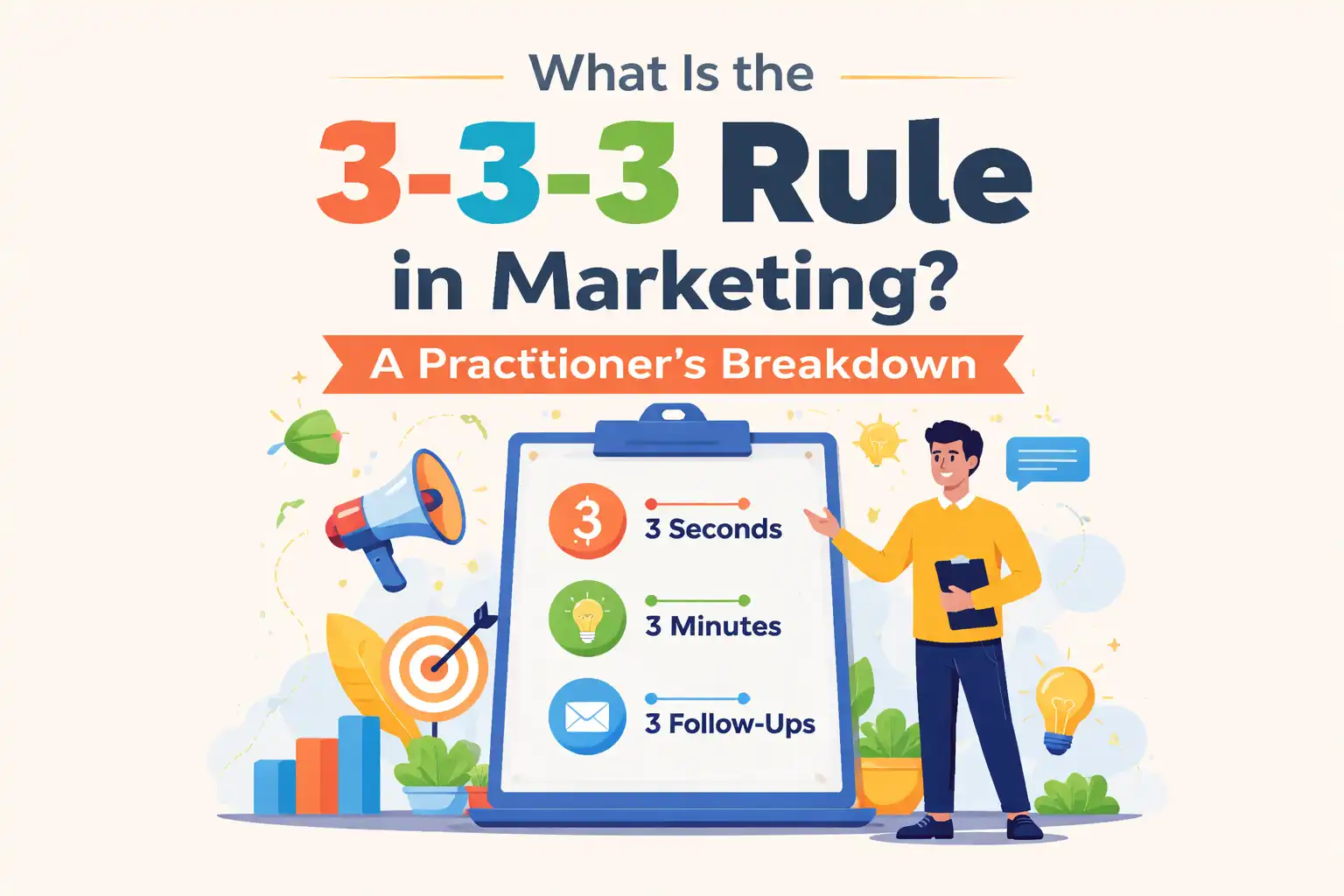
The 3-3-3 rule in marketing is a framework that dictates you have three seconds to grab attention, three seconds to deliver value, and three seconds to drive action. It originated in advertising but now governs how AI search engines decide whether to surface your content. If your page fails the first three-second retrieval test, it never reaches a human. Most practitioners know the rule from ad copy or email subject lines, but in 2026 the same clock is running for machines. This article breaks down how the 3-3-3 rule applies to both human attention and machine understanding, and what it means for content that needs to survive both.
Defining the 3-3-3 Rule in Marketing
The rule traces back to direct-response advertising, where copywriters realized that readers decide within seconds whether to engage or bounce. The three stages break down like this: the first three seconds are for grabbing attention with a headline, visual, or opening hook. The next three seconds are for communicating value — why should this matter to the reader? The final three seconds are for prompting action, whether that click, sign-up, or purchase.
You see this play out daily. An email subject line has about three seconds to earn an open. A social ad has three seconds to stop the scroll before the thumb moves on. A landing page hero section has three seconds to convince someone not to hit back. The Microsoft study from 2015 clocked the average human attention span for online content at under eight seconds, which means the entire 3-3-3 window is tight even by generous estimates.
Traditional channels made this relatively straightforward. You wrote a punchy headline, surfaced the benefit quickly, and ended with a clear CTA. The rule worked because the human brain processes visual and emotional triggers fast. A bright color, a bold font, a provocative statement — these shortcuts bypassed rational filtering and pulled the reader in.
How the 3-3-3 Rule Applies to Content and Product Pages
When you move from ads to content pages and ecommerce product detail pages, the 3-3-3 rule gets harder to execute. A product page has to serve multiple functions: inform, persuade, and convert. The structure has to be scannable because 73% of consumers read fewer than five words on a product page before deciding whether to stay or leave. That is an industry estimate that has held up for years.
The first three seconds on a product page are dominated by the hero image, the title, and the price. If those don’t communicate value instantly, the visitor is gone. The next three seconds are for the subhead or first bullet — what makes this product worth their time. The final three seconds are for the add-to-cart button or the trust signal. Many Shopify and WooCommerce stores fail at step two. They bury the benefit in a wall of text below the fold, or they lead with brand messaging instead of answering the customer’s immediate question: does this solve my problem?
Common mistakes include long introductions that treat the page like a blog post, weak CTAs that get lost in design, and missing value props above the fold. If you are selling a chair, the first thing a visitor should see is not your company story — it is “adjustable lumbar support” and “free returns.” The 3-3-3 rule for product pages is a discipline of ruthless editing. Every element above the fold has to earn its place, or it is noise.
For those running stores on the Shopify ecommerce platform, the default theme templates often bury key selling points under fold lines or in accordion sections. The 3-3-3 rule forces you to rethink that layout. Test by loading your page and timing yourself: can you identify the headline, the value proposition, and the CTA within three seconds? If not, the page needs restructuring.
The 3-3-3 Rule in the Age of AI Search

The shift from human-only attention to machine-first processing changes everything about the 3-3-3 rule. AI search engines like ChatGPT, Google AI Overview, and Perplexity evaluate content in a strict three-stage pipeline: retrieval, comprehension, and recommendation. Each stage has a three-second equivalent — the time it takes for the system to decide whether to index, understand, or cite your content. And here is the non-obvious part: AI systems are actually more sensitive to this rule than humans are, because if your page fails at the retrieval stage, it never reaches comprehension. There is no second chance.
Most ecommerce pages fail at retrieval. They are optimized for human eyes but not for the semantic signals that AI systems need to classify and rank content. Structured data is missing, comparison content is absent, and FAQ sections are nowhere to be found. According to internal data from VISNIB, 91% of ecommerce stores lack AI-search-ready comparison content. That means nine out of ten stores are invisible to AI search engines before a three-second retrieval window even starts.
Consider a real example. One ecommerce brand spent months optimizing their product pages for traditional SEO — meta tags, clean URLs, Core Web Vitals. They never added comparison content or FAQ pages. After the March 2026 Google core update, their organic traffic dropped 40% because AI Overviews started intercepting the query-level intent that their pages could have covered. They assumed the 3-3-3 rule only applied to ad copy, not to machine comprehension. By the time they realized the gap, the traffic loss was already a month old.
This is where traditional product pages fail the AI retrieval stage. They contain no structured comparison between alternatives, no multi-angle FAQ answers, no data tables that AI systems treat as trust signals. The content might be well-written for a human, but it is semantically thin for a machine. Tools like VISNIB exist to surface exactly these gaps — they scan your product catalog against what AI search engines look for and tell you which semantic entities are missing. The idea is to fill the content holes before a machine decides your page is not worth understanding.
The second non-obvious observation here is that the 3-3-3 rule operates in reverse for AI. You must design content to be machine-readable in the first three seconds before it can ever be human-readable. That means scannable structure, clear entity references, comparison tables, and FAQ markup matter more than creative flair. A beautifully written product description that lacks these signals will get ignored by AI search engines, no matter how good it reads.
Practical Steps to Align Your Marketing with the 3-3-3 Rule for AI Visibility
Auditing your content against the AI version of the 3-3-3 rule means checking three stages. First, does your content get indexed fast? That is the retrieval stage. Technical SEO basics apply, but also the presence of structured data (Product schema, FAQ schema) and fast server response times. If your site takes more than three seconds to respond to a crawl request, you have already lost the retrieval window.
Second, does your content contain the right semantic signals for comprehension? AI systems look for comparisons, pros and cons, pricing discussions, and multi-grain answers to common questions. If you sell a laptop, you need pages that compare it to competitor models, explain why it might be better for specific use cases, and answer “is this laptop good for video editing?” in plain language. These are not blog posts for traffic; they are semantic content that helps AI understand the product’s position in the market. This step is where most ecommerce brands are weakest.
Third, does your content prompt AI to cite it as an authority? That means having external links, citations, and a pattern of being referenced by other authoritative sources. AI systems track citation velocity — if your content gets cited by other pages or by AI answers themselves, it accumulates trust over time. One case study from VISNIB showed that AI-generated citations can increase three times within two months when content gaps are filled systematically. That is not a hypothetical number; it came from a brand that went from zero to thirty citations in sixty days just by adding structured comparisons and FAQ pages.
Monitoring this process is not optional anymore. Relying on traditional rank tracking tools tells you nothing about whether AI systems include your products in their answers. You need a different kind of feedback loop. Tracking AI visibility isn’t optional anymore — that is a reality that took a 40% traffic drop for a client to teach me. VISNIB runs scans on your product catalog and reports which pages ChatGPT and Google AI Overview are citing, which competitors are being mentioned instead, and what semantic entities you are missing. The monitoring itself becomes the iteration loop: fill a gap, rescan, see if citations increase.
Start with one product category. Create a comparison page that lines up your product against two main competitors or alternatives. Write a FAQ page that answers seven to ten real questions customers have asked. Add FAQ schema to both pages. Then monitor for two weeks. If you see zero AI citations, the problem is likely in the semantic depth of your content. Go back and add more contextual discussion — not fluff, but genuine comparisons and use-case explanations. This is not a one-time project. The AI landscape updates frequently enough that content gaps shift. The 3-3-3 rule for AI visibility requires continuous scanning.
For those who want to dig deeper into why typical ecommerce pages fail this test, The Gap Between Your Shopify Store and What AI Search Engines Actually Read explains the specific structural differences between content that AI systems trust and content they ignore.
FAQ
Q1: What exactly is the 3-3-3 rule in marketing?
It is a framework that says you have three seconds to grab attention, three seconds to communicate value, and three seconds to prompt action. Originally developed for advertising and copywriting, it is now used in content marketing, email marketing, and increasingly for AI search optimization.
Q2: Does the 3-3-3 rule still work for AI search?
It works differently. AI search engines process content in three analogous stages — retrieval, comprehension, recommendation — each with its own tight window. The rule still applies, but the “attention” you are trying to capture is machine attention, and the signals are semantic structure rather than visual hooks.
Q3: How is the 3-3-3 rule different from the 3-second rule?
The terms are sometimes used interchangeably, but the 3-3-3 rule is more structured because it defines three distinct stages with specific objectives. The 3-second rule typically refers only to the initial window to capture attention before a user bounces.
Q4: Can I use the 3-3-3 rule for email marketing?
Yes. The subject line is the first three seconds to earn an open. The preheader and opening sentence are the next three seconds to communicate value. The CTA is the final three seconds to prompt a click. Many email marketers focus only on the subject line and neglect the rest.
Q5: What happens if I ignore the 3-3-3 rule in my content strategy?
Your content will underperform in both traditional search and AI search. For human readers, you lose engagement and conversions. For AI systems, your pages fail the retrieval or comprehension stage and never get cited. Over time, competitors who structure their content for the 3-3-3 rule will capture both the clicks and the AI recommendations you are missing.
Share Article