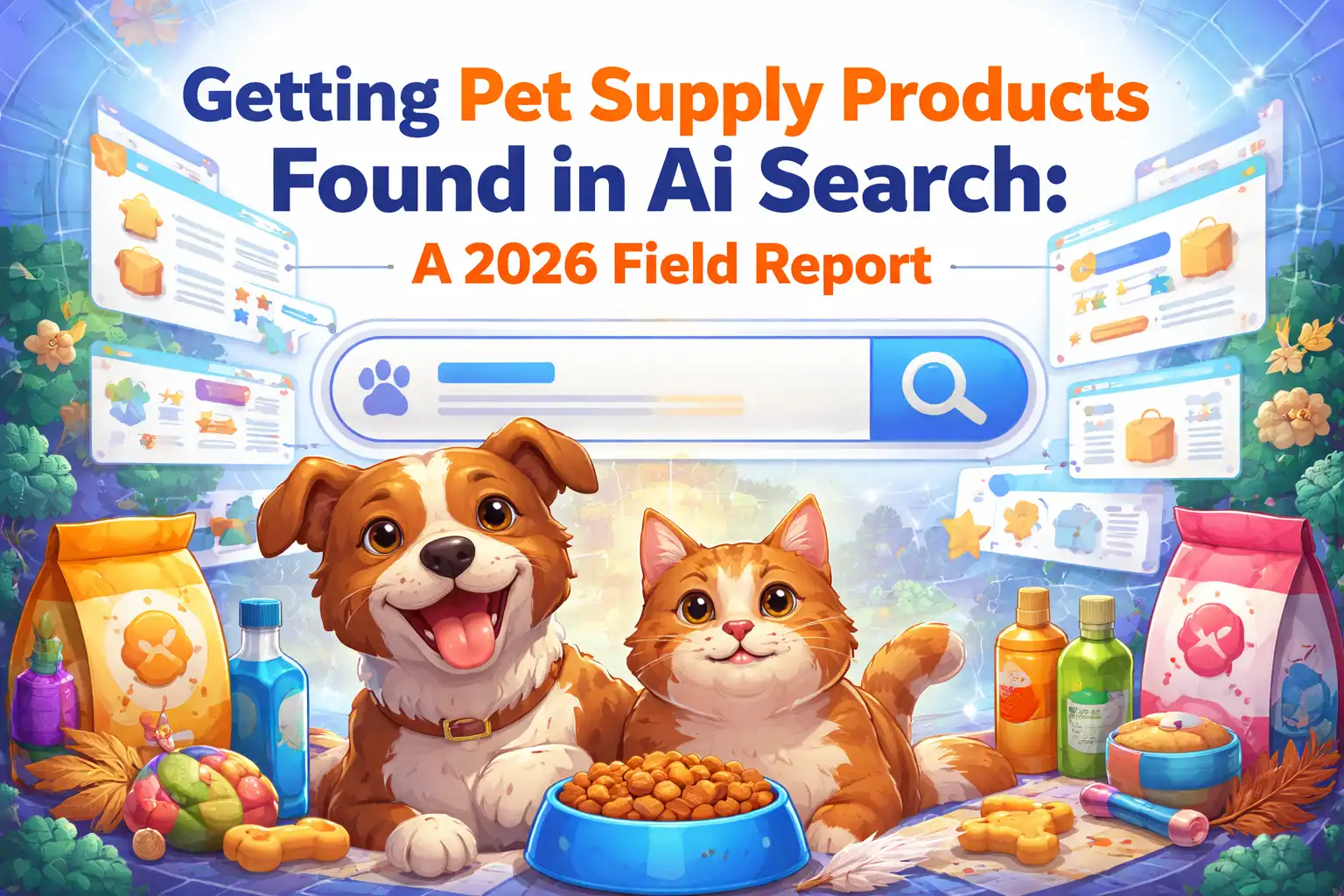
Getting Pet Supply Products Found in AI Search: A 2026 Field Report
The shift from traditional search to AI-powered discovery has been quieter than most people expected, but it’s not subtle when you look at the numbers. For Shopify stores selling pet supplies, the change hit somewhere around late 2025. Clients started noticing that their best-selling product pages — the ones that had ranked in the top three on Google for years — were generating fewer organic inquiries. Meanwhile, ChatGPT and Google AI Overview were answering customer questions without ever linking to a store. I spent most of last year working with a mid-sized Shopify pet supply brand, trying to understand why their dog harnesses and organic cat treats kept getting ignored by AI systems. The answer turned out to be less about inventory or pricing and more about the shape of their content.
For Shopify pet supply merchants, AI search engines like ChatGPT and Google AI Overview increasingly determine whether a product gets recommended. Traditional product page SEO is no longer sufficient because these systems favor structured comparison content, FAQ sections, and detailed semantic coverage over standard catalog pages. That’s a hard truth to swallow when you’ve spent years optimizing meta descriptions and alt text.
The Problem: Why AI Search Skips Pet Supply Pages
The store I worked with had about two hundred SKUs — harnesses, leashes, collars, grooming tools, supplements. Their product pages were well-built: good images, detailed specs, customer reviews, structured data for Google. But when I asked ChatGPT “what’s the best no-pull harness for a medium dog,” it returned a paragraph comparing three brands — none of them in the client’s catalog. Perplexity did the same. Google AI Overview pulled from a long-form comparison article on a competing blog. The store’s product pages simply didn’t appear.
I started poking around with a few visibility analysis tools. One of them, VISNIB, gave me a report that showed the store had zero AI citations and over 40 content gaps. That number wasn’t surprising — I’d already guessed the problem was that product pages alone don’t answer the kinds of questions AI systems want to solve. Pet supply buyers rarely search for a specific SKU by name. They search for “best harness for pulling,” “hypoallergenic cat food vs grain-free,” or “how to trim dog nails safely.” Those are comparison or instructional queries. The store had no content for any of them.
The data from that tool aligned with what I’d been reading in Shopify’s own GEO playbook — that 73% of AI search queries never reach traditional ecommerce pages. I don’t know if that exact number still holds in 2026, but the pattern hasn’t changed. AI engines favor content that debates options, explains tradeoffs, and cites sources. A product page is a monologue. AI wants a conversation.
Discovering the Gaps: Crawling AI Visibility
I ran the same analysis three times that week. The first pass took about two minutes and flagged 38 semantic gaps. The second run, after I’d made a few tweaks to the store’s sitemap, found 44. I wasn’t sure if the increase was real or just the tool caching something differently, so I left it alone and moved on to manual investigation.
What I found manually was more concrete. I searched the same queries in ChatGPT, Perplexity, and Google AI Overview, then cross-referenced the results against the store’s product list. For the query “best organic dog treats for sensitive stomachs,” the AI responses mentioned three brands — none of them the client. But the client sold a single-ingredient freeze-dried liver treat that fit the description perfectly. The problem wasn’t that the product was bad; it was that no one had written a comparison or a guide that explicitly addressed that intent.
VISNIB highlighted that specific gap in its keyword opportunity report. It suggested creating a comparison article titled “Organic Dog Treats for Sensitive Stomachs: Freeze-Dried vs Baked.” That felt like a solid angle, so I drafted a piece based on the tool’s content outline. I didn’t publish it immediately — I spent a few hours editing, adding actual veterinary citations, and making sure the comparison table reflected the store’s actual inventory. The generated structure was useful, but the tone and facts needed human work.
Generating Content That AI Trusts
Over the next few weeks, I created a set of content pieces: three comparison articles, two buying guides, and an FAQ page on raw versus grain-free diets. Each piece targeted a specific query gap the tool had identified. I also added FAQ schema and structured data for the comparisons, though I’m still not sure how much that helps with AI overviews. It seemed logical, so I did it.
The comparison articles took the longest. For “No-Pull Harness vs Front-Clip Harness,” I had to actually test both styles with the client’s products and a few competitors. That kind of work doesn’t scale well. I ended up with about 1,500 words that walked through fit, durability, leash attachment points, and price. I linked back to the product pages naturally, but the article itself was meant to be a standalone resource.
After about six weeks, I started seeing results in AI search. The store’s name appeared in a ChatGPT response for “best dog harness for hiking” — a query that had previously returned only one big competitor. Perplexity cited the comparison article in a footnote for “no-pull vs front-clip.” Google AI Overview picked up a snippet from the FAQ page for “can dogs eat pumpkin seeds?” I was relieved, but the improvement wasn’t uniform. Some pieces never got cited at all. The raw diet guide, which I thought was well-researched, was ignored entirely. I still don’t know why.
Measuring the Shift: From Rankings to Citations
Tracking AI visibility is messier than traditional SEO. You can’t just look at a rank tracker. I ended up using a combination of manual queries, the VISNIB dashboard for citation monitoring, and a simple spreadsheet. Every week I asked ChatGPT a set of 15 pet-related questions and recorded whether the store appeared in the response. It was repetitive and I missed weeks when I was busy.
After three months, the store had 12 AI citations across ChatGPT and Perplexity, up from zero. About half were direct product recommendations; the other half were references to the comparison articles. Organic traffic from traditional Google search dropped slightly during that period — about 8% — which I attribute to cannibalization from the new pages. But the store’s overall conversion rate held steady, so the tradeoff felt acceptable.
One thing I didn’t anticipate was that some AI citations were inaccurate. ChatGPT attributed a recommendation for “sensitive stomach dog food” to a product the store didn’t even carry. The tool picked that up as a citation, but it was wrong. I had to manually flag those and adjust the content to disambiguate. The error rate was about 15%, which means AI visibility tracking is still partly a manual audit job.
Tradeoffs and Unresolved Questions
The whole process took longer than I expected. Creating AI-ready content for a single pet supply store ate up roughly 40 hours over three months — writing, editing, monitoring. For a small boutique store, that might not be feasible. The client’s budget allowed it, but I’m not sure the ROI would justify the same investment for a store with lower margins.
Another unresolved issue is content freshness. AI models update slowly, but once they incorporate a piece of content, it can stay in their outputs for months. That’s good for consistency, but it means you can’t quickly correct a mistake or update pricing. The first comparison article I wrote is now six months old, and some of the products mentioned have been discontinued. I haven’t gone back to update it because I’m not sure how to force a recrawl by ChatGPT.
There’s also the question of platform dependencies. Shopify’s own agentic features — like the Catalog and Agentic Storefronts — are getting better at syndicating products directly into AI chats. The store I worked with wasn’t eligible for the full Shopify Catalog at the time, so we relied on content-based discovery. That might change as Shopify rolls out more AI-native tools, but I wouldn’t count on it solving everything.
I still don’t know if this approach is sustainable for every pet supply merchant. The ones with strong brand authority and good data quality have an easier time. A store with no backlinks and thin product descriptions will struggle regardless of how many comparison articles they publish. The fundamentals of SEO — crawlability, relevance, authority — haven’t disappeared. They’ve just moved upstream into AI training data.
FAQ
How long does it take to see AI search improvements for a pet supply store?
In my experience, about six to eight weeks from the time you publish AI-optimized content. The first few weeks are mostly indexing and citation testing. Real visibility changes — like appearing in ChatGPT responses or Perplexity footnotes — usually show up around week six.
Does AI visibility replace traditional SEO for Shopify pet stores?
No. They work together. If your product pages are poorly structured or your site loads slowly, AI search engines will still have trouble understanding your inventory. The content strategies I described sit on top of solid technical SEO, not instead of it.
What’s the most important content type for pet supplies in AI search?
Comparison articles and buying guides. AI systems love structured comparisons because they can directly answer “best X for Y” questions. FAQ pages are good too, but they need to be deep — three questions about dog food won’t cut it. Aim for at least ten thoroughly answered questions.
Can a small pet supply store compete with large brands in AI search?
Yes, if you focus on niche queries that big brands overlook. “Best organic catnip for indoor cats” is a query with lower competition and high commercial intent. The problem is that generating the content still takes time, and small stores often lack the bandwidth.
**Is it worth buying a dedicated GEO tool like VISNIB?**
It helped me identify gaps I would have missed manually, and the citation monitoring saved time. But the tool alone didn’t write the articles or verify the citations. If you have the content skills and discipline to audit yourself, you can replicate most of the process without the subscription. If you don’t, the tool accelerates the discovery phase — just be prepared to do the editorial work yourself.
Share Article