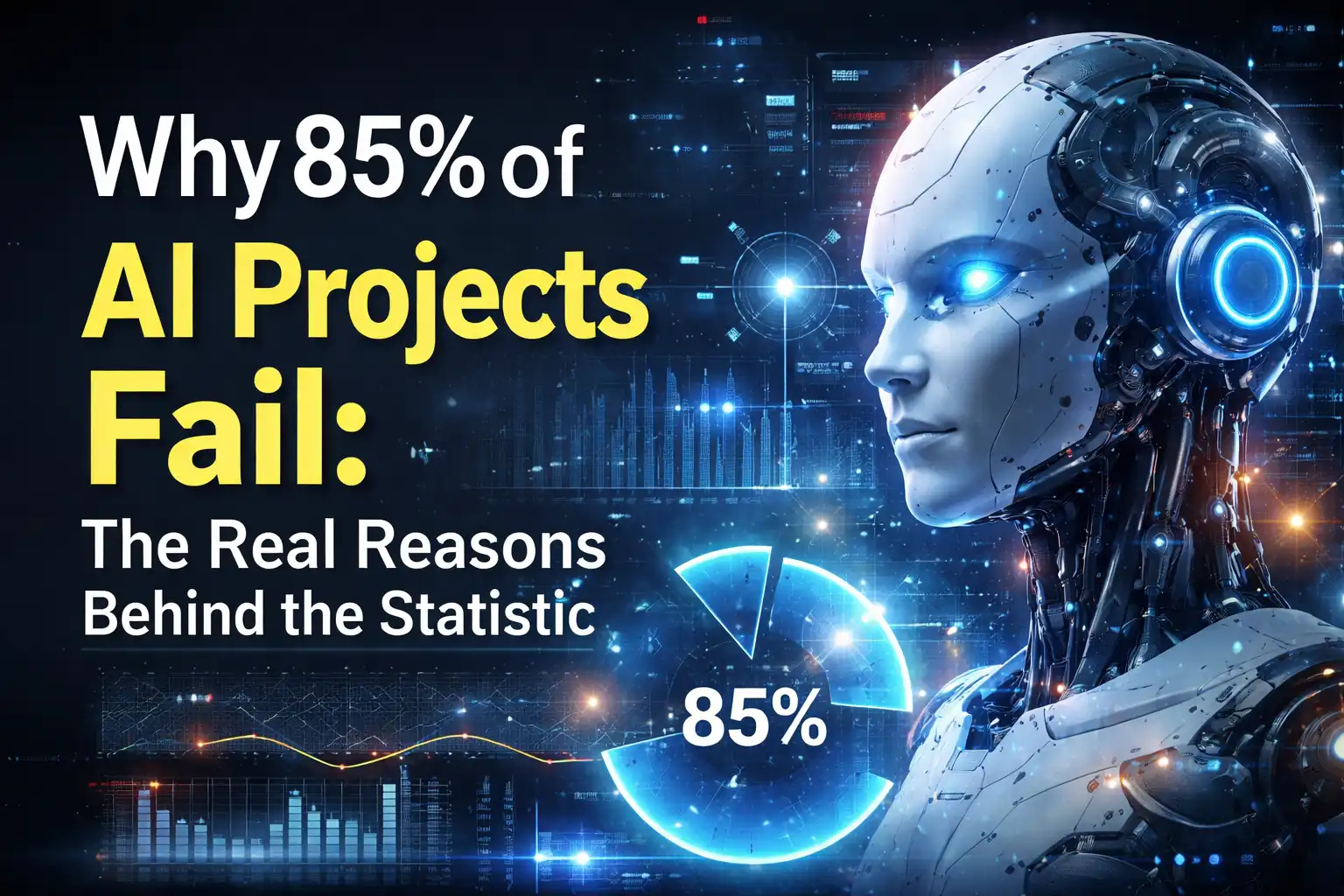
Why 85% of AI Projects Fail: The Real Reasons Behind the Statistic
A team spends eight months building a recommendation engine. In testing, it achieves 94% accuracy — the model correctly predicts what users will click, what they’ll add to cart, and when they’re about to churn. The engineering lead presents the results to the executive team. Everyone is impressed. Six months after deployment, the project is quietly shelved. Revenue didn’t move. The sales team ignored the recommendations. No one budgeted for the weekly retraining cycles. The model was technically excellent and operationally dead on arrival.
That story repeats across industries more often than most people realize. The commonly cited statistic — 85% of AI projects fail — gets thrown around in conference keynotes and vendor pitches, but the postmortems rarely tell the full story. After watching this pattern unfold across multiple teams, I’ve come to believe the real killers aren’t what most analyses focus on. The failures are rarely about bad algorithms or insufficient data volume. The hidden causes are boring operational factors: misaligned metrics that look good in a dashboard but mean nothing to the business, data pipelines that silently rot after the data science team moves on, and maintenance budgets that never made it past the first quarter.
What the 85% Statistic Actually Means
The number traces back to research from Gartner and McKinsey, though versions of it appear in nearly every industry report on AI adoption. The 2019 Gartner study pegged the failure rate at 85%, and follow-up surveys have landed in similar territory. What most people miss is how that statistic defines failure. It does not mean the models didn’t work technically. It means the projects failed to deliver expected return on investment.
A machine learning model can achieve 97% precision on a test set and still be a failure by this definition if the business expected a 20% revenue lift and got 2%. A computer vision system can correctly identify defects on an assembly line with 99% accuracy, but if the maintenance team never trusted the alerts and kept relying on manual inspection, the project delivered no operational value.
This distinction matters because it changes where you look for root causes. If failure were mostly about model performance, the fix would be better data science. But when failure is about business value delivery, the root causes live in the organizational and operational layers — the metrics you chose to optimize, the stakeholders you didn’t include in the design phase, the monitoring infrastructure you never built.
Another common misinterpretation is conflating proof-of-concept failure with production failure. Many organizations have dozens of successful proofs-of-concept that produced accurate models in Jupyter notebooks. Those same projects never made it into production because no one planned for the infrastructure costs, the ongoing data pipeline maintenance, or the integration work required to connect the model to the systems that actually run the business. The 85% statistic includes all of these as failures, which means a majority of AI initiatives die between an impressive demo and a deployed system.
Misalignment Between Technical Goals and Business Needs
The most common failure pattern I’ve observed starts with a metrics mismatch. The data science team optimizes for model accuracy, precision-recall curves, or AUC scores — technically meaningful metrics that have no direct relationship to the business KPIs the executive team cares about. The model looks great on paper, but no one asked whether improving click-through rate by 12% would actually move revenue, or whether the operational cost of serving the model outweighed the incremental lift.
I worked with an ecommerce team that built a product recommendation engine. In offline testing, it outperformed their existing rules-based system by a wide margin on click-through rate. They deployed it to production. Click-through rate went up exactly as predicted. Revenue stayed flat. The recommendations were pushing higher-click products with lower margins, and customers who clicked those recommendations were actually less likely to complete a purchase. The model was doing exactly what it was optimized to do, and the business got nothing from it.
If your model improves click-through rate but your revenue stays flat, ask why. The answer usually involves a gap between the proxy metric the team optimized for and the actual business outcome the company needed. Cross-functional teams that include business stakeholders from the beginning tend to avoid this trap. When OKRs are defined jointly by data scientists and the business side, the model’s optimization target maps directly to a business KPI — conversion value instead of CTR, customer lifetime value instead of short-term engagement.
Industry surveys suggest around 40% of failed AI projects cite misalignment with business objectives as a primary cause. That number lines up with what I’ve seen in practice. The teams that succeed tend to be the ones that spend the first two weeks of a project agreeing on what success actually looks like, and those definitions always include a measurable business outcome, not a model performance metric.
For brands operating in the ecommerce space, this alignment question extends into how products are represented to AI-powered search and recommendation systems. If your product content isn’t structured in a way that AI models can interpret semantically, even a technically sound recommendation engine will fail to surface the right items. A practical example is covered in this field report on getting pet supply products found in AI search, which walks through the content structure changes that helped one Shopify brand bridge the gap between technical optimization and actual AI visibility.
The Data Pipeline and Quality Ambush
Dirty data is the most cited technical reason for AI project failure, but the problem runs deeper than missing values or duplicate records. The real ambush happens at the pipeline level — the infrastructure that moves data from source systems into the model, keeps it current, and ensures the output reaches the systems that act on it.
A commonly referenced VentureBeat survey found that 87% of data science projects never make it to production. The bottleneck is almost never the modeling work. It’s the data engineering required to keep a pipeline running reliably at production scale. Feature stores, data versioning, automated quality checks — these components are unglamorous and easy to deprioritize during the project planning phase, but their absence is what kills projects after the model is ready.
Consider an ecommerce brand running a personalized pricing model. The data pipeline pulls product inventory, competitor pricing, and customer purchase history from multiple sources. In development, the team uses a static snapshot of clean, curated data. The model performs well. In production, the pipeline breaks on the third day because the competitor pricing API changed its response format. No one notices for two weeks because there’s no monitoring on the data freshness. By the time someone catches it, the model has been serving stale predictions that make no sense — and the business team has already lost confidence in the system.
The semantic quality of data matters as much as its cleanliness. AI models, particularly large language models and embedding-based retrieval systems, depend on the semantic structure of the content they process. A product page with clean metadata but thin, unstructured product descriptions will not be understood the same way by an AI system as a page with rich, comparison-driven content that mirrors how people actually ask questions.
Most ecommerce platforms like Shopify’s ecommerce platform provide the raw infrastructure to host product content, but they don’t automatically structure it in ways that modern AI retrieval systems can process. The semantic gap between what a merchant enters in a CMS field and what an AI search engine needs to confidently recommend that product is wider than most teams realize. This is a content structure issue, not a data quality issue, and it requires a different kind of fix.
Many brands are beginning to systematically address these semantic gaps. A breakdown of the most frequently missed content structures can be found in this analysis of semantic gaps ecommerce brands overlook in AI search, which covers the specific content patterns — comparison tables, intent-driven FAQs, authoritative third-party citations — that AI retrieval systems use to determine whether to surface a product.
The Maintenance Burden No One Budgets For — and Where Most Projects Die
The team celebrates the launch. The model is live, the dashboards are green, and the initial metrics look promising. Three months later, performance has started to drift. Six months in, the model is returning recommendations that don’t match current inventory. Twelve months after launch, no one remembers the system exists. The project didn’t fail at deployment. It decayed.
Model decay is not a hypothetical edge case. Production models lose accuracy over time as the data they were trained on becomes less representative of current conditions. Concept drift — where the statistical relationship between input features and target outcomes changes — happens gradually but consistently. A reasonable estimate is that model performance decays around 5% per month without retraining. Over a year, that compounds into a model that performs worse than the simple rule-based system it replaced.
The maintenance burden that kills AI projects is not just technical — it’s organizational and financial. Retraining cycles require ongoing engineering bandwidth. Monitoring infrastructure, alerting systems, and performance dashboards need to be built and maintained. Someone has to own the process of deciding when a model needs retraining and verifying that the new version actually improves performance. These roles are rarely budgeted for in the initial project plan.
I’ve seen teams that built excellent models, deployed them, and then disbanded because the organization assumed the project was “done.” The data scientists moved to the next initiative. The engineering team went back to maintaining the core product. No one owned the monitoring. By the time someone noticed the model was producing bad output, the damage to stakeholder trust was irreversible.
This is where tools that help track how AI systems understand and surface content over time become relevant. VISNIB is one such approach — it monitors whether AI search engines and recommendation systems can still correctly interpret your product catalog as inventory, pricing, and content change. The visibility analysis tells you not just whether your model is performing, but whether the underlying semantic signals the model depends on are still intact.
The maintenance problem also extends to content. If your AI system surfaces products based on structured content, that content needs to be updated as the catalog evolves. New products need comparison pages. Old FAQs need to be revised. Competitor positioning shifts. All of these changes affect how an AI model understands your offering. Content gap detection — identifying topics and query patterns your content doesn’t cover — becomes a maintenance task, not a one-time project. Without it, the model’s output quality degrades even if the model itself is functioning correctly.
As one practitioner noted while working on similar problems, tracking AI visibility isn’t optional anymore — the gradual decline in how AI systems reference your content happens silently, and by the time you notice the traffic drop, the recovery window may have closed.
Organizational Resistance and the Human Factor
A model can produce perfect recommendations and still fail if the people who are supposed to act on those recommendations don’t trust them. This is not an irrational response. When a sales rep has been doing their job for ten years and a black-box algorithm starts telling them to prioritize accounts they’ve never considered, skepticism is a reasonable default.
Organizational resistance to AI systems takes multiple forms. The most obvious is explicit refusal to adopt the system’s outputs. More common — and harder to detect — is silent non-adoption: people keep using the old workflow, check the AI recommendations occasionally, and then quietly ignore them when they conflict with intuition.
Change management is consistently underfunded in AI initiatives. The technology gets the budget. The training, the workflow redesign, and the cultural adoption work get a line item that gets cut in the first review cycle. Studies on digital transformation initiatives suggest around 70% fail, and the failure patterns overlap heavily with AI project failures. The root cause is rarely the technology. It’s the organization’s inability to absorb the change.
The most common pattern I’ve observed: a champion inside the organization drives the AI project. They build cross-functional buy-in, navigate the procurement process, and push through the initial deployment. Then the champion either leaves the company or gets promoted to a different role. No one else in the organization has the context or the conviction to maintain the system. The project quietly dies.
Platform-level integration also plays a role. AI systems need to connect to existing infrastructure in ways that respect existing workflows. Ecommerce platforms like Shopline’s ecommerce infrastructure are an example of an ecosystem where AI integration requires not just technical compatibility but organizational alignment — the marketing team, the merchandising team, and the operations team all need to agree on how the system fits into their processes.
The technical changes required for AI adoption often force organizational changes that no one anticipated. For DTC brands, this is especially visible in the shift required to make product content AI-search-ready. Structured data, schema compliance, and semantic content patterns require marketing and content teams to work differently. An analysis of AI-first SEO and DTC brand visibility in 2026 illustrates how what looks like a technical schema problem actually becomes an organizational adoption problem — the content team has to internalize a new way of writing product descriptions, and the operations team has to audit structured data that previously no one touched.
The teams that succeed with AI projects tend to share one characteristic: they treat the human adoption work as equally important as the modeling work. They invest in training, they build feedback loops where users can override the system and feed those overrides back into the model, and they plan for the transition period — usually three to six months — where the system’s outputs coexist with existing workflows until trust is earned.
FAQ
Q1: What does the 85% failure rate actually measure?
It measures the percentage of AI initiatives that fail to deliver expected return on investment, not the percentage that fail technically. A project can produce an accurate model and still be counted as a failure if the business outcomes — revenue, cost savings, operational efficiency — don’t materialize. The statistic comes from Gartner and McKinsey research and has been reproduced across multiple industry surveys.
Q2: Are AI projects more likely to fail than traditional software projects?
Yes, by most available data. Traditional software projects have failure rates in the 30-40% range depending on the methodology used. AI projects fail at roughly double that rate. The gap is best explained by the additional uncertainty layers in AI work: model performance cannot be fully verified before deployment, data quality degrades over time in ways traditional software doesn’t experience, and the organizational trust barrier is higher for systems that make probabilistic recommendations rather than deterministic output.
Q3: How can a company avoid the most common AI project failures?
Start by defining success in business terms before writing any code. The project’s optimization target should map directly to a revenue or cost metric, not a model performance metric. Budget for ongoing maintenance — retraining cycles, monitoring infrastructure, and content updates — from the beginning. Include the people who will use the system in the design phase, and plan for a transition period where the system’s outputs coexist with existing workflows rather than replacing them overnight.
Q4: What is the single biggest factor in AI project success?
From what I’ve observed, the strongest predictor of sustained success is whether the project solves a narrow, well-defined problem with clear ownership. The most successful projects are boring by AI standards: a straightforward classification model that automates a tedious manual process, or a simple regression model that helps a pricing team make faster decisions. The projects that fail tend to be the ambitious ones that try to transform an entire business process at once.
Q5: Can small businesses succeed with AI despite the high failure rate?
Yes, and in some ways small businesses have an advantage. Smaller teams mean fewer stakeholders to align, shorter communication chains, and faster decision cycles. The key is starting with a problem that has a measurable outcome and a simple solution. Complex, multi-model systems that require data from ten different sources rarely work in small organizations. A single model trained on one clean data source that automates one specific decision — that pattern works at any scale.
Share Article