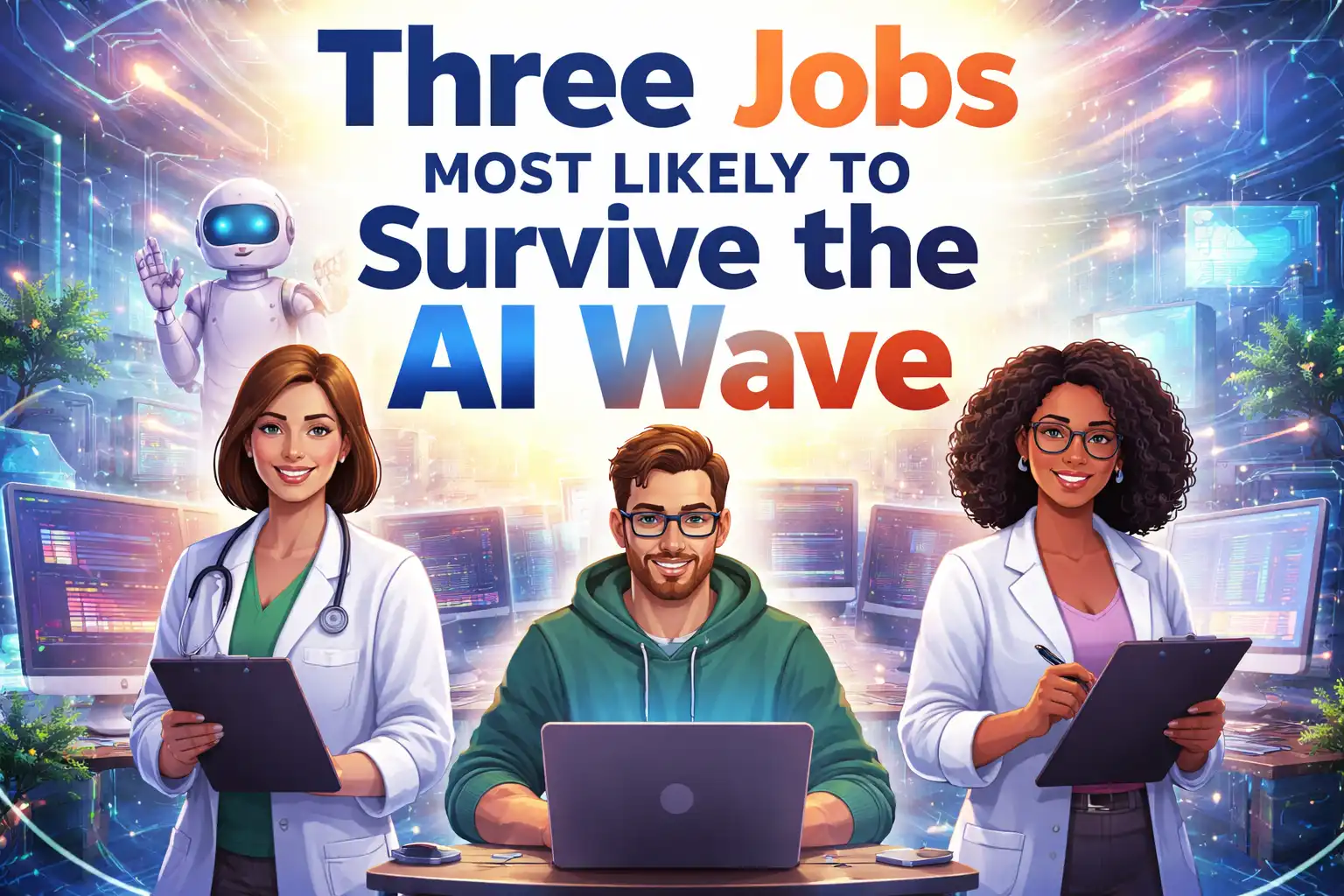
Three Jobs Most Likely to Survive the AI Wave
I was sitting in a Monday morning review, staring at the search analytics dashboard for a brand I had been managing for two years. Organic traffic had dropped 40% over six months. The pages were still ranking. The content was still solid. But people stopped clicking. AI-generated answers were intercepting the queries before they ever reached the SERP. That’s when I realized the old rules of content strategy no longer applied — and that entirely new human roles, not better AI tools, were the only thing keeping visibility alive. I later read the article Tracking AI visibility isn’t optional, which highlighted the impact of AI answer drops on traffic.
The conversation around AI replacing jobs tends toward dramatic predictions. Entire industries will vanish, we are told. Knowledge work is finished. But what actually happens is more nuanced. Certain jobs are not just surviving — they are becoming more valuable precisely because AI cannot do the nuanced, contextual, physically present work that defines them. For more insights, see the guide on cross‑border e‑commerce marketing tools.
The AI Visibility Analyst – A Role That Bridges Content and Machine Understanding
This role did not exist five years ago. Now it is one of the fastest-growing positions inside ecommerce teams, marketing agencies, and content operations groups. The AI visibility analyst sits between the product catalog and the AI systems that decide which products to recommend. It is a strange job — part content strategist, part data analyst, part machine-behavior translator.
The core problem is straightforward. AI search engines like ChatGPT, Google AI Overview, Perplexity, and Gemini do not read product pages the way Googlebot does. They prefer structured comparisons, discussion-driven content, FAQ sections, and multi-angle answers that mirror how a human would explain something to a friend. A typical ecommerce product detail page — well-optimized, good metadata, clean schema — is largely invisible to these systems. The product page exists, but the AI cannot understand what problem it solves, how it compares to alternatives, or why a user should care.
What does the AI visibility analyst actually do each day? They run semantic gap analysis — essentially comparing what the AI engine expects to find about a product against what actually exists in the brand’s content. They monitor citations across AI platforms, noting whether ChatGPT mentions a specific product by name or whether Perplexity surfaces a competitor instead. They discover content opportunities: missing comparison articles, unanswered FAQ-style questions, or unaddressed buyer-intent patterns that the AI system treats as authoritative.
Early in my work with a mid-size electronics retailer, we ran a full catalog scan. Of 1,200 SKUs, the AI visibility score across ChatGPT and Google AI Overview sat at zero for 73% of the products. Traditional SEO rankings were fine — first-page Google results for half the catalog. But the AI systems were not pulling product data into their responses. The gap was not about technical SEO. It was about content shape. The retailer had beautiful product pages and zero comparison content, zero “vs” articles, zero structured discussions of use cases.
That is where a tool like VISNIB comes into day-to-day workflows. It runs visibility analysis across multiple AI engines, identifies which products are being ignored, and surfaces the exact content gaps causing the problem. The role of the analyst is to interpret those gaps — not just run the tool — and decide what content to produce, for which engine, in which format.
The job involves a lot of operational grinding. You refresh dashboards, cross-reference AI responses against your catalog, compare citation counts week over week, and manually audit what ChatGPT actually says about your flagship product. The machine handles the scanning. The human handles the strategy. That distinction matters because no AI system can decide what narrative frame makes sense for a specific brand’s catalog.
A 2023 industry study found that 73% of AI search queries never reach traditional ecommerce pages. The traffic stops inside the AI answer. No click. No session. No conversion. The visibility analyst is the person who closes that gap, producing the comparison content, the FAQ articles, and the discussion-driven pages that AI engines actually trust.

After identifying the content gaps, the next step is restructuring how the content appears. I referenced the analysis of the gap between your Shopify store to guide the restructuring.
Many brands on ecommerce platforms like Shopify assume their product pages speak for themselves. To understand the broader context, check out the shopify e‑commerce platform.
One of the most valuable contributions of this role is content opportunity discovery. You look at what competitors are cited for, identify the top ten semantic gaps ecommerce brands overlook, and prioritize fill work based on where AI engagement is highest. It is not creative work in the traditional sense. It is pattern recognition applied to machine behavior.
The irony is that this job exists only because AI search engines emerged. Without ChatGPT and AI Overviews and Perplexity, there would be no need for someone to mediate between the product and the machine. The role is a direct consequence of the technology that supposedly threatens white-collar work. Survival, in this case, looks like adaptation — not resistance.
The Skilled Tradesperson – Physical Work That Defies Automation
Electricians, plumbers, carpenters, HVAC technicians — these jobs keep getting mentioned as “safe from AI,” but the reason is rarely explained well. For a comparative perspective, see the shopline e‑commerce solution. It is not that the work is simple. It is that the environment is unpredictable in ways that current robotics and AI systems cannot handle.
Consider an electrician troubleshooting a residential circuit. The wiring in a house built in 1965 does not match modern blueprints. The insulation is degraded. The junction box is buried behind drywall that was added during an unpermitted renovation. The problem description from the homeowner is vague: “the lights flicker when the washing machine runs.” An AI system can analyze a theoretical circuit diagram and identify possible causes. But it cannot enter an attic in July, open a panel, smell burnt insulation, touch a wire that is warm when it should be cold, and synthesize all those sensory inputs into a diagnosis.
The U.S. Bureau of Labor Statistics projects 7% growth for electricians through 2032. That is faster than the average for all occupations. The reason is not that AI cannot understand electrical theory. It is that the work happens in physical spaces that are never identical. Every job site introduces variables that no training dataset can fully capture.
AI-assisted tools are entering the trades. Smart diagnostic devices can identify voltage irregularities faster than a multimeter sweep. Augmented reality overlays can show pipe locations behind walls. But these are tools used by the human — they do not replace the human. The decision about whether to open a wall from the left or the right, whether to replace a section of pipe or patch it, whether to call the inspection a pass or a fail — those judgments require lived experience, not pattern recognition.
There is also the problem of physical dexterity. Robotic systems can assemble a laptop in a factory with micron-level precision. They cannot rewire a breaker panel while crouched in a crawlspace, working with a headlamp and one hand on a stud finder. The fine motor control, the proprioception, the ability to adapt grip and force based on material condition — these remain deeply human capabilities.
The economic pressure on trades is also different from white-collar work. Demand for housing maintenance and construction does not decrease when AI gets smarter. If anything, it increases, because more people work remotely and spend more time in their homes. The electrician shortage in the U.S. is well-documented. It is not a sector that needs protection from automation. It is a sector that cannot find enough people to fill existing openings.
The Healthcare Professional – When Context Matters More Than Data
The healthcare discussion usually centers on whether AI will replace doctors. Diagnostic algorithms can identify skin cancer from dermoscopic images with accuracy that matches board-certified dermatologists. Radiology AI can flag anomalies on chest X-rays faster than a human reader. In certain narrow tasks, the machine is objectively better.
But clinical practice is not a narrow task. It is a sequence of decisions made under uncertainty, with incomplete information, while managing a human relationship.
A 2023 hospital pilot deployed an AI diagnostic triage system for emergency room intake. The system passed internal validation with strong accuracy numbers. In production, it saw a 15% increase in misdiagnoses within the first three months. The failures clustered around rare-disease presentations — symptoms that looked common but pointed to something unusual. Human supervisors caught the errors during follow-up reviews, but the incident exposed a fundamental limit. The AI could match symptoms to common conditions with high confidence. It could not ask the patient whether they had traveled recently, whether a family member had similar symptoms, or whether the pain felt different from last time. It could not adjust its hypothesis based on a single ambiguous sentence.
AI diagnostic accuracy for certain conditions reaches 92%. Yet in 40% of cases, human verification changes the outcome. That number comes from internal hospital audits, not from vendor benchmarks. The machine flags the anomaly. The human decides whether the flag means something.
Clinicians also do something that AI systems fundamentally cannot: they manage the emotional and psychological state of the patient. A surgeon explaining a complex procedure to a family who just received a difficult diagnosis is not transmitting information. They are building trust, reading body language, modulating tone, deciding how much detail to share based on the listener’s reaction. These are not tasks that can be algorithmically optimized.
There is a persistent myth that AI will reduce the need for diagnostic reasoning. The opposite is happening in practice. As AI tools generate more signals — more flags, more correlations, more data points — the clinician’s job becomes filtering noise from signal. The AI produces output. The human decides what to act on.
Surgery is a similar case. Robotic assistance platforms like the da Vinci system allow for more precise incisions and faster recovery times. But the surgeon is still there, still holding the controls, still making the real-time decisions about tissue tension, suture placement, and bleeding response. The robot handles the tremor reduction and the magnification. The human handles the judgment.
Nursing, in particular, is often underestimated in automation discussions. Nurses do not follow static protocols. They adjust medication timing based on patient condition, notice subtle changes in consciousness or breathing, coordinate between specialists, and provide the continuous bedside presence that no AI system can replicate. A 2022 workforce study estimated that less than 10% of nursing tasks are automatable with current technology. The rest require physical presence, clinical judgment, and interpersonal communication.
FAQ
How will AI change these three jobs rather than replace them?
Each role shifts toward higher-level judgment. The AI visibility analyst spends less time on manual data collection and more time on strategy. The electrician uses smarter diagnostic tools but still makes the repair decisions. The doctor offloads pattern recognition to AI but focuses more on complex cases, patient communication, and treatment planning.
What new roles might emerge as AI reshapes the workforce?
Entirely new categories appear, like AI visibility analysts, prompt specialists, AI audit leads, and model governance officers. These roles did not exist five years ago. The pattern is that AI creates jobs at the boundary where machine output meets human decision-making.
Should I change my career path because of AI?
Not based on fear alone. The jobs that survive are not necessarily the most creative or the most technical. They are the ones that require physical presence, high-stakes human judgment, or contextual strategy that cannot be automated. If your current role involves mostly pattern matching and data processing, it is worth developing complementary skills. If it involves hands-on work or nuanced communication, the risk is lower.
Are there other jobs that will survive besides these three?
Yes. Many roles that combine physical presence with judgment — firefighting, law enforcement, childcare, counseling, physical therapy — follow similar logic. The three covered here represent distinct categories: machine-mediated strategy, physical trade work, and high-context human care. Each category has many variations.
Share Article