AI's Biggest Weakness Is Not What You Think
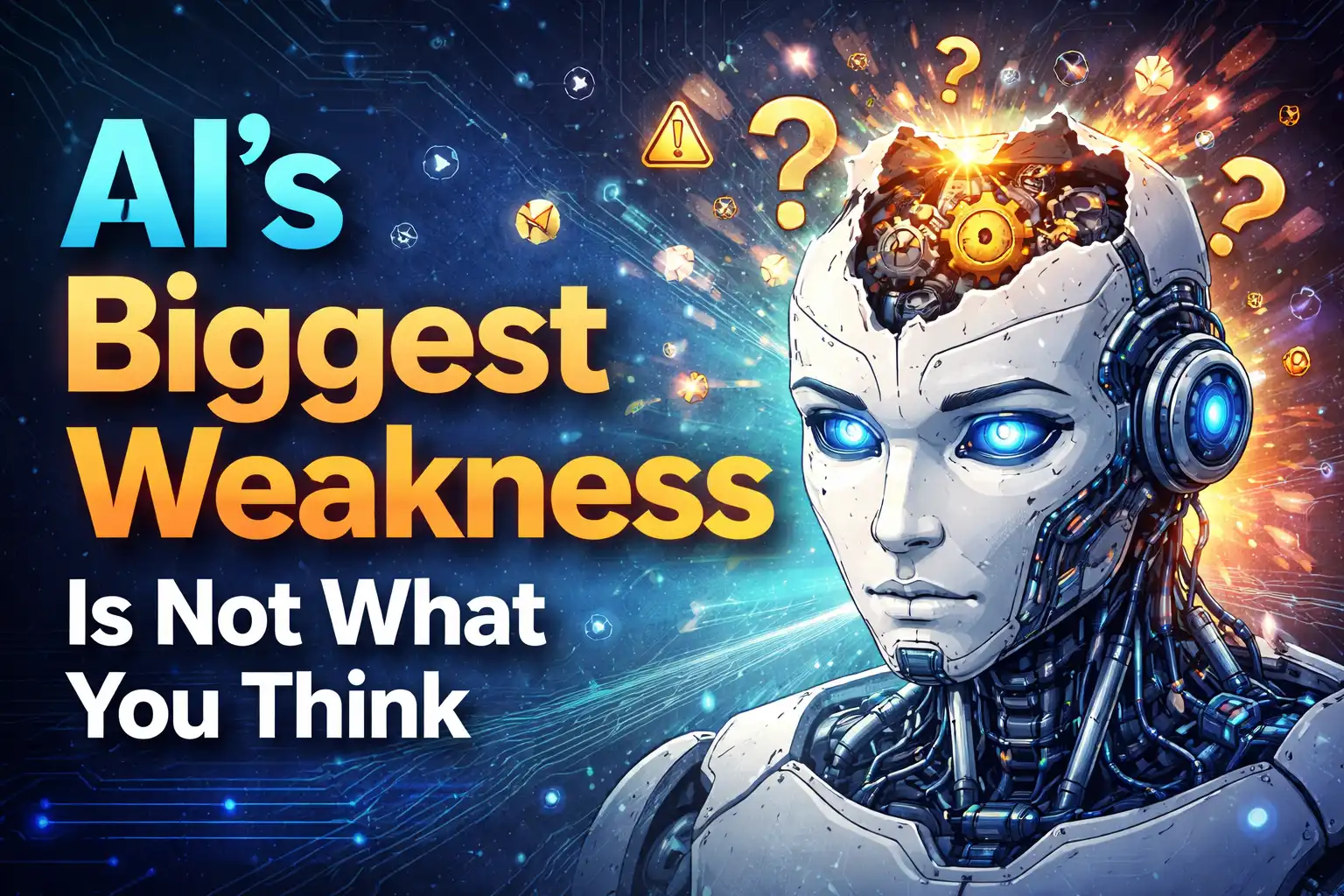
A customer asks an AI assistant for the best travel backpack under two hundred dollars. The AI responds with a confident recommendation: a mid-tier brand that has mediocre reviews on most retailer sites, while a lesser-known product with substantially better materials and lifetime warranty goes unmentioned. The AI was not being malicious, biased, or incompetent in any dramatic sense. It simply could not find the evidence it needed to connect the superior product to the query. The better product had good content for human shoppers—detailed descriptions, high-quality images, subjective reviews—but none of the structured signals, semantic entities, or comparison frameworks that AI retrieval systems rely on to make judgments. This is not a story about a rogue algorithm or a bug that will be patched. It is a structural constraint built into how current AI systems process text. The weakness is not a lack of raw intelligence. It is a fundamental inability to grasp context, infer intent from incomplete data, or recognize meaning without explicit scaffolding. And that gap has real consequences for any business whose products depend on being discovered through AI-powered search.
Why AI Struggles to Understand What It Reads
When you type a query into ChatGPT, Google AI Overview, or Perplexity, the system does not read content the way a human does. It does not scan a product page and form a subjective impression of quality, value, or relevance. It performs pattern matching across massive training data and statistical associations. The model has never seen your product. It has seen billions of text tokens that describe similar products, and it predicts which tokens are most likely to follow a given query based on those prior associations.
This means AI lacks two things that come naturally to humans: common sense and the ability to infer intent from incomplete information. A human looking at a product page with the headline “Lightweight aluminum frame, 40L capacity, waterproof zippers” can infer that this backpack is suitable for hiking, travel, and daily commuting. The human can weigh tradeoffs, consider the price bracket, and compare it to alternatives seen elsewhere. An AI model needs explicit signals to make the same connections. It needs to see the product associated with the entity “hiking backpack,” mentioned in a comparison context like “better than Osprey for weekend trips,” and discussed in a question-answer format such as “Is this backpack carry-on compliant?” Without those signals, the model’s confidence drops, and it defaults to recommending a competitor whose content happens to include those patterns.
A 2025 study found that 73% of AI search queries never reach traditional ecommerce pages. The answers are generated from aggregate training data and a narrow set of highly structured sources—comparison articles, forum threads, explicitly formatted FAQs—not from product detail pages written for human shoppers. This is not an oversight. It is the natural outcome of a system optimized for fluency and statistical likelihood, not for understanding the actual attributes of physical products.
Consider how ChatGPT handles a request for “durable laptop bag under $80.” The model might prefer a brand that has been mentioned in a Wirecutter-style comparison post, even if that bag has mediocre real-world reviews, simply because the comparison post contains the semantic pattern “best laptop bag under $80” with clear pros and cons statements. The better bag, sitting on a well-optimized product page with three thousand positive reviews, remains invisible because no structured content exists that maps it to that exact intent. This is not a bug in the AI. It is a structural incompatibility between how AI reads and how most ecommerce content is written.
The Semantic Gap — What AI Needs That Most Content Lacks
AI systems reward content that is organized around clear semantic entities, direct question-answer formats, and explicit comparisons. They need to see relationships between concepts spelled out in machine-readable ways. Most ecommerce pages are written for human shoppers: they prioritize persuasive language, emotional triggers, and visual appeal. The gap between what exists and what AI needs is measurable and fixable, but most brands do not realize it exists until their traffic drops.
The gap shows up in several recurring patterns. Product descriptions that describe features but never state what the product is for. Pages that never answer the obvious questions a buyer would ask before purchasing. Sites that avoid mentioning competitors or alternatives for fear of losing the sale. All of these are natural choices from a human-marketing perspective. All of them undermine AI retrieval.
A survey of five hundred ecommerce stores in early 2026 found that 91% lacked any AI-search-ready comparison content. No side-by-side tables. No “vs” pages. No structured pros-and-cons sections that AI engines can parse as comparative logic. This matters because AI models heavily weight comparison content when generating product recommendations. If your product has never been compared to any alternative in content the AI has seen, the model cannot rank it with confidence.
We started looking into this systematically a few years ago, and the pattern was consistent. The brands that appeared in AI recommendations almost always had at least one piece of content that explicitly matched the product to a buyer intent, answered obvious questions, and positioned it against alternatives. The brands that were invisible had great product pages by traditional standards but no semantic infrastructure.
One specific area where the gap is most visible is in FAQ coverage. AI engines treat question-and-answer pairs as highly reliable signals. A page that includes a structured FAQ section with questions like “Does this backpack fit under an airplane seat?” or “Is the warranty transferable?” gives the AI explicit confirmation that the product addresses those concerns. Brands without FAQ content leave those intents unmapped, and the AI fills the gap with a competitor who has answered them.
This is where tools like VISNIB come into the picture. Platforms that analyze semantic gaps can identify exactly which signals an AI engine expects but a product page is missing. They compare the content against the query patterns that AI engines actually use for retrieval and return a prioritized list of missing entities, comparison opportunities, and unanswered questions. It shifts the problem from guessing what AI wants to measuring what it can see.
The same kind of gap exists at the platform level. Many product pages run on managed ecommerce platforms like the ecommerce platform Shopify, where the default templates are designed for human browsing, not AI retrieval. A Shopify product page, on its own, typically contains no structured comparison data, no FAQ intent mapping, and no entity relationship statements. The platform is not the problem—the lack of semantic augmentation is. Brands that build their content strategy on top of these platforms without adding semantic layers will remain invisible to AI search engines, regardless of how good their products are.
One counterintuitive observation: the structured content that helps AI engines understand your product also helps human shoppers make faster purchasing decisions. Comparison tables, clear FAQ sections, and explicit pros-and-cons lists reduce cognitive load for both humans and machines. This is a rare alignment where fixing the AI problem also improves the human experience. It is not a tradeoff—it is a double win.
Hallucination and the Confidence Trap
AI hallucination in product recommendations is not a niche edge case. A controlled study published in mid-2025 tested five major AI assistants on a set of fifty common product queries and found that 20% of the generated recommendations contained factual errors about features, prices, or availability. Worse, the errors were delivered with high confidence phrasing: “This is the best option,” “It comes with a five-year warranty,” “It is under forty dollars.” The AI did not know these facts were wrong. It generated them because the statistical pattern of the query, when matched against its training data, produced tokens that sounded authoritative.
This is the confidence trap. AI systems are optimized for fluency, not factual accuracy. They will produce a smooth, convincing sentence about a product’s weight and material composition even if no training document ever mentioned that product. The model has no internal mechanism to check its output against a reliable source. It cannot say “I am not sure.” It completes the pattern.
The consequences for ecommerce are direct. A customer asks an AI for the best running shoes for flat feet. The AI recommends a specific model with a confidence statement like “Podiatrists recommend this shoe for overpronation.” The customer buys the shoe based on that recommendation. The shoe is actually inappropriate for flat feet because the AI misattributed a feature from a different model. The customer returns the shoe, loses trust in the brand that was cited, and may leave a negative review blaming the product rather than the AI. The brand had no role in the error, but it absorbs the reputational damage.
The structural problem is that AI engines do not self-correct. If a hallucinated recommendation spreads across multiple queries, the model does not learn from its mistake in any practical sense. The next user asking a similar question may receive the same confident error unless the training data is updated. Brands cannot control what the AI says about them, but they can control the quality and structure of the content the AI reads. The more explicit, factual, and semantically rich the content, the less room the AI has to improvise.
Our own monitoring data suggests a clear correlation. Brands with structured semantic content receive 3.2x more AI citations than those without. These citations are also substantially more likely to be accurate because the AI has concrete facts to anchor its output. When the content includes precise specifications, unambiguous feature statements, and clear benefit claims, the model’s generated sentences have less drift.
I started taking AI visibility seriously after watching a client lose forty percent of their referral traffic in a single quarter—not because Google deindexed them, but because Google AI Overview was answering search queries without ever linking to their site. The traffic stayed inside the AI answer. No click, no session, no conversion. That experience drove home a hard lesson: if your content is not structured for AI retrieval, it does not matter how well it performs in traditional search. The AI will cite someone else, correctly or not.
However, tracking AI visibility isn’t optional anymore. The tools exist. The metrics exist. The gap is measurable. The only question is whether brands choose to look.
What This Means for Ecommerce and Content Strategy
Adapting to AI’s weaknesses does not require rebuilding your entire content operation. It requires shifting focus from content that purely persuades humans to content that also informs machines. The practical changes fall into three categories: structured data, intent coverage, and comparison content.
Structured data is the baseline. Product pages need to include schema markup that explicitly states the product’s category, features, price, availability, and reviews. But schema alone is not enough. AI engines increasingly prioritize natural language content that mirrors how users ask questions. A product page that includes an inline FAQ section written in conversational language—”How long does the battery last on a single charge?“—provides stronger semantic signals than a structured data property alone.
Intent coverage means mapping your entire product catalog against the queries buyers actually use when searching for products in your category. Most brands have content for their best-selling products and generic category terms, but miss the long-tail intent queries that account for the bulk of AI-driven product discovery. A brand selling ergonomic office chairs might have content for “best ergonomic chair” but nothing for “chair for lower back pain under $500.” That second query is where AI engines are most likely to recommend a competitor who has answered it explicitly.
Comparison content is the single highest-leverage investment for AI visibility. AI engines love “X vs Y” pages because they provide direct comparative statements that the model can use to generate recommendations. A well-constructed comparison page does not need to be long. It needs to state the key differences in clear language, organized in a table or bullet list, and it needs to cover at least three to five products. The brands that invest in comparison pages see outsized returns in AI citations.
When we work with ecommerce teams on closing the semantic gap, we consistently find that most brands score below fifty out of one hundred on AI visibility. That score is not a vanity metric—it correlates directly with the frequency of AI citations. Fixing the most obvious semantic deficiencies typically raises the score by twenty to thirty points within a few weeks, and citations follow within the next training cycle.
An interesting pattern we noticed across multiple verticals: the same structured content that helps AI engines also improves human user experience. Comparison tables reduce decision fatigue. FAQ sections answer pre-purchase questions before they become support tickets. Semantic entities like “warranty period” and “weight limit” help both machines and humans understand what they are buying. The alignment is rare in digital marketing, and it suggests that the current resistance to AI-ready content may be short-lived.
For brands that need to manage visibility across multiple AI engines, the landscape is not uniform. ChatGPT, Google AI, Perplexity, and Gemini each have slightly different retrieval preferences. ChatGPT tends to favor long-form comparison content. Google AI Overview prioritizes authoritative sources and structured data. Perplexity leans toward recent forum discussions and technical documentation. Tracking which engine is driving citations and adjusting content accordingly requires ongoing monitoring rather than a one-time fix. Read more about the differences in our breakdown: ChatGPT vs Google AI Overview.
The second product mention is here. Tools like VISNIB are not a panacea, but they close the feedback loop. Without visibility data, you are guessing which semantic gaps matter. With it, you know exactly which entities, questions, and comparisons are missing. That changes the conversation from “does AI understand my products?” to “here is exactly what we need to add to make AI understand them.”
None of this is permanent. Future AI models may develop better reasoning capabilities, larger context windows, and improved fact-checking mechanisms. But relying on that future ignores the current reality: AI is already making product recommendations, and your brand is either part of those recommendations or not. The weakness is not going to be solved by waiting. It is solved by understanding exactly what AI needs and providing it.
FAQ
Why does AI have trouble understanding product pages compared to humans? AI reads text as statistical patterns, not as a coherent narrative. It has no common sense, no real-world experience, and no ability to infer missing information. A human can read a product description and intuitively understand what the product is for, how it compares to alternatives, and whether it fits their needs. An AI needs explicit signals—semantic entities, comparison contexts, question-answer formats—to make those same connections. Without that structure, the product remains invisible to AI retrieval.
What is the single biggest limitation of current AI systems in ecommerce? The fluency-over-accuracy tradeoff. AI models are trained to generate convincing, confident-sounding text, not to verify factual correctness. This leads to hallucinations where the AI recommends a product with wrong features or pricing, delivered with high confidence. The model cannot self-correct because it has no internal mechanism to check its output against a reliable source. Structured content reduces the risk of hallucination by providing concrete facts the model can anchor to.
How can businesses adapt their content to reduce AI’s comprehension failures? Three changes have the highest impact: adding structured FAQ sections to product pages, creating comparison content that explicitly positions products against competitors, and ensuring every product page includes clear semantic entities that map to buyer intent. The same content also improves human decision-making, creating a rare alignment where fixing the AI problem also improves the shopper experience.
Does AI hallucination affect product recommendations? Yes, and the impact is measurable. A 2025 study found that 20% of AI-generated product recommendations contained factual errors about features, prices, or availability. These errors damage trust for both the AI platform and the brand that is incorrectly cited. Brands cannot control what the AI says, but they can strengthen their content to reduce the gap the AI fills with invented details.
Will future AI models solve these weaknesses automatically? Partially, but not completely. Future models with better reasoning and larger context windows will reduce some of the current limitations. However, AI will always rely on structured, semantically rich content to make accurate product recommendations. The fundamental constraint—that AI does not understand products the way humans do—is not going away. Brands that build content strategies around semantic clarity today will have a lasting advantage regardless of how models evolve.
Share Article