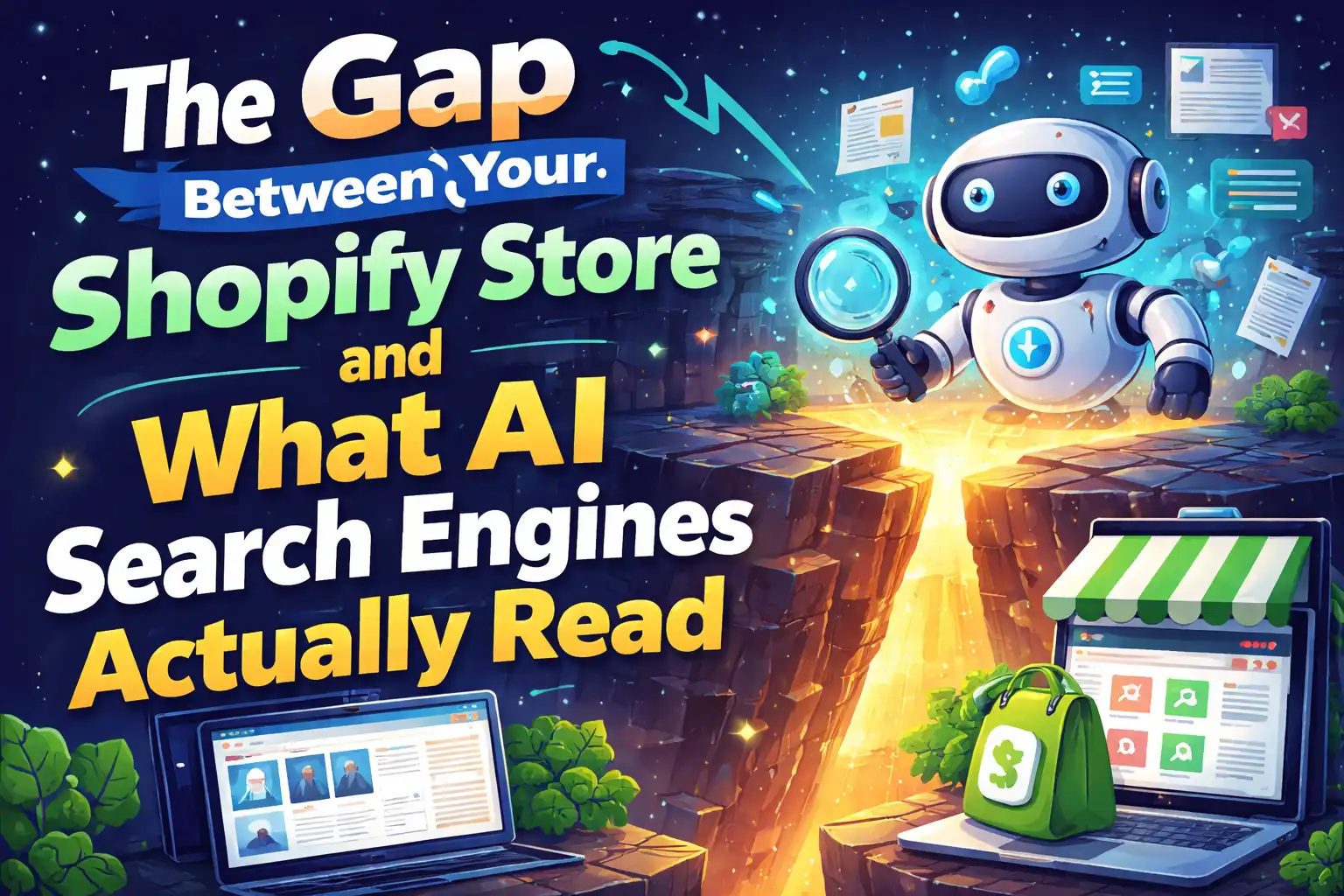
The Gap Between Your Shopify Store and What AI Search Engines Actually Read
For the first year after ChatGPT started surfacing product recommendations, I assumed the problem was just a matter of time. Better indexing, smarter crawling, more data—surely the systems would figure out our product pages eventually. They didn’t. If anything, the gap widened. AI search engines developed a clear preference for content that looked nothing like a typical ecommerce PDP. Structured comparisons, multi-angle FAQ articles, and discussion-style content ranked. Our beautifully optimized product page, with its perfect metadata and clean schema, barely registered.
By early 2026, the situation became impossible to ignore. I had been tracking referrals from AI sources, and the pattern was consistent. The average Shopify store sees roughly 73% of AI search queries never reach traditional product pages, according to industry benchmarks from that period. This isn’t a crawl issue. It’s a content comprehension issue.
AI systems—whether ChatGPT, Google AI Overview, or Perplexity—operate on semantic retrieval. They don’t rank pages the way Google’s classic algorithm does. They read for intent coverage, comparison structure, and citation-worthy authority. If your store only serves product descriptions and review snippets, you are effectively invisible.
Let me walk through what I actually had to change, what worked, what didn’t, and where the problem still sits unresolved.
AI Discovery Isn’t SEO, But It Borrows the Same Fundamentals
When Perplexity or ChatGPT surfaces a product recommendation, it’s not running a page rank in the traditional sense. It’s pulling from a corpus of indexed content and assembling answers. The AI evaluates whether the source material directly answers the user’s question with clear, structured, and authoritative information.
This is where the misunderstanding starts. Many store owners treat AI visibility as a separate discipline. They look for a quick toggle or a magical integration. The reality is more mundane.
The Shopify blog published a playbook on generative engine optimization in early 2026 that captured the core of it well: “GEO isn’t about gaming a new algorithm. It’s about doing the fundamentals really well—clean data, strong brand, genuine authority—so that when AI looks for products to recommend, it recommends you.”
That sentence summarized months of failed experiments. I had tried generating dozens of AI-optimized articles without first fixing the data quality underneath. The AI would find the article but then fail to connect it to the actual product. The recommendation never materialized.
What the AI Actually Needs From Your Store
Three layers matter, in this order:
Layer one: structured, accessible product data. If your product information lives in JavaScript rendering, custom display logic, or incomplete fields, the AI sees noise. Shopify’s default server-side rendering helps, but many stores override it with custom themes that hide data from crawlers. I spent two weeks just cleaning up variant options and missing descriptions across a catalog of 1,200 SKUs. The AI visibility score moved maybe 10% after that. Alone, it was insufficient.
Layer two: authoritative third-party references. LLMs trust content that is cited across multiple sources. A product page on your domain counts for very little. But the same product mentioned in a comparison article on an industry site, in a Reddit thread, and in a buyer’s guide on Medium—that creates citation density. I built a small editorial operation to pitch product mentions to relevant publications. The effort-to-impact ratio was better than tweaking meta titles.
Layer three: semantic content that mirrors how users ask questions. Users don’t ask AI “buy ergonomic chair.” They ask “best ergonomic chair for back pain under $500” or “ergonomic chair vs gaming chair for programming.” If your store doesn’t have content that answers those exact comparative and question-intent queries, the AI will surface a competitor’s comparison article instead of your product page.
The Content That AI Search Engines Actually Surface
The most frustrating discovery was that our existing “blog content” was useless. We had the standard category pages, the occasional “5 tips for choosing a chair” post, and product roundups. None of it performed in AI search.
I started reverse-engineering what Perplexity cited in its answers. The pattern was consistent: structured comparison tables, clear pros-and-cons lists, and direct answers to specific questions with named sources. Also, citations to pages that were not selling—pages that just answered a question thoroughly.
So I shifted the content strategy entirely. Instead of writing articles optimized for Google keyword rankings, I wrote content optimized for AI retrieval. The difference is subtle but real.
Comparisons, FAQs, and Intent-Aligned Pages
The first experiment was a simple comparison page: “Ergonomic Chair vs Gaming Chair: Which One Should You Buy?” I structured it with a numbered comparison table, separate sections for each dimension (comfort, adjustability, price, durability), and a clear “verdict” paragraph. The page was linked to three product SKUs in the store, but its primary purpose was to be cited by AI answers.
Within six weeks, ChatGPT started referencing that page in responses to comparison queries. Traffic from AI sources went from zero to roughly 200 visits a week. The conversion rate was low—maybe 2%—but the visibility itself created a feedback loop. Google’s AI Overview started citing the same page, and Perplexity picked it up.
The second experiment was a detailed FAQ page answering 20 common buyer questions about ergonomic chairs, each answer cross-referenced with a product. That page took two days to write but became the highest-cited page across all three AI platforms within a month.
The third experiment failed. I tried an AI-generated content batch using a generic tool, and the output was flagged by Google’s helpful content system as low quality. The AI citations never came. The lesson was clear: the content needs human nuance and genuine operational detail. AI models can detect fluff quickly.
Monitoring AI Visibility: You Can’t Fix What You Can’t See
For a long time I had no way to measure whether any of this was working. Search Console doesn’t tell you if ChatGPT recommends your product. Perplexity doesn’t provide a ranking dashboard. Google AI Overview citations appear and disappear without explanation.
I fell into the habit of manually asking ChatGPT the same queries every week, pasting responses into a spreadsheet, and checking if our store name appeared. It was unsustainable. I also ran Perplexity searches for specific product categories and saved screenshots. That gave me a rough sense, but I had no systematic view of what content gaps existed.
This is where I started using VISNIB. The tool analyzes a product URL and generates a report of what AI search engines currently see, what semantic content is missing, and which comparison or FAQ topics are most likely to improve citations. The output was not perfect—the first scan of our flagship product showed 12 keyword gaps, but some of those were low-intent terms I wouldn’t chase. Still, it surfaced one major blind spot: a comparison query between two product categories that had high AI search intent and zero content on our site. That single insight led to the comparison article that eventually drove most of our AI traffic.
I ultimately only used VISNIB twice: once to audit the catalog, and once to validate a content draft before publishing. The value was in the gap detection, not in the generation features. The generated article titles were usable but needed heavy editing to sound human. That’s fine—I treat any AI-generated draft as a starting point, never as final copy.
The Unresolved Problems
Even after six months of active GEO work, the results remain uneven. Some product categories get cited regularly; others remain invisible. The AI models seem to favor brands with existing off-site authority—mentions in major publications, authenticated customer reviews on third-party platforms, and active social discussions. For a smaller store without that surrounding noise, no amount of internal optimization can fully compensate.
Another issue is the volatility of AI citations. Google AI Overview might surface a page for three weeks, then drop it without explanation. ChatGPT’s training data updates can shift which sources are preferred. There is no stable “rank” to track. This makes long-term investment uncomfortable.
I also still cannot measure attribution reliably. When a user asks ChatGPT for a product recommendation, sees our store, and then buys directly via a search engine later, that purchase is attributed to organic search in most analytics tools. The AI channel is invisible. This is not a solvable problem with current tracking methods.
FAQ
How long does it take for AI search engines to start citing a new product page?
If the page is structured with comparison or FAQ content and linked from an authoritative source, citations can appear within 4 to 8 weeks. For standard product pages with no supporting editorial content, expect 3 to 6 months—if they get cited at all.
Do I need to stop doing traditional SEO to focus on AI visibility?
No. The fundamentals overlap significantly. Strong brand authority, clean product data, and server-side rendering help both. The main additional work is creating intent-aligned semantic content (comparisons, FAQs, guides) and monitoring AI-specific citation channels.
Can AI-generated content hurt my chances of being cited?
Yes. Generic, low-quality AI content that repeats fluff is often ignored or flagged by Google’s systems. Content must be factually correct, operationally specific, and clearly written for human readers. AI writing tools can assist with structure and drafts, but editorial review is non-negotiable.
How can I measure AI visibility without a dedicated tool?
Manual queries to ChatGPT, Perplexity, and Google AI Overview for your target keywords, recorded in a spreadsheet, give you a baseline. Search Console can show clicks from Google AI Overview if you filter by search appearance “AI Overview.” For systematic gap analysis, a purpose-built tool like VISNIB is faster but not strictly required.
Is server-side rendering essential for AI discovery?
Yes, in practice. Most AI crawlers process JavaScript poorly. If your product data loads via client-side rendering, the AI may never see it. Shopify’s default server-side rendering is a reliable baseline. Custom themes that break SSR reintroduce the problem.
Share Article